
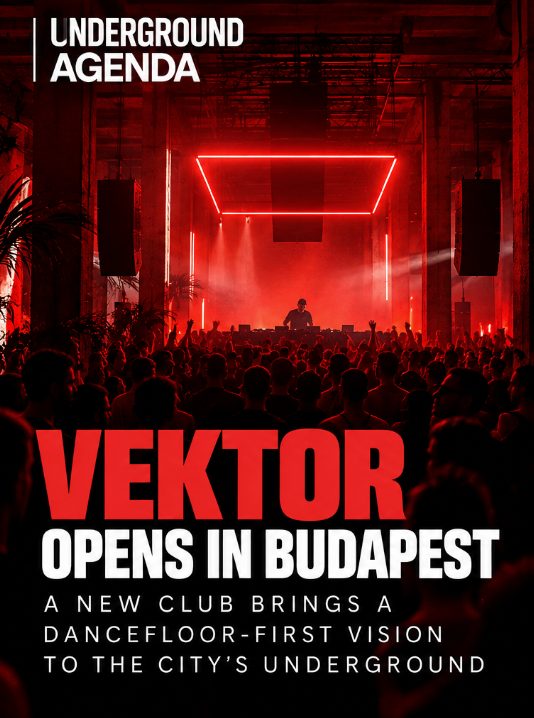
Budapest is about to add a new club to its underground electronic landscape.
On October 16, VEKTOR will open its doors for the first time inside Gozsdu Court, introducing a new venue built around a simple idea: place the dancefloor at the centre of the experience.
The opening night, titled Soakin’ Groove, brings together Paris-based DJ and producer Sicion with residents AGA2L, Daniel Moritz, Rovizz and THIRD 2HIFT. Resident Advisor has selected the event as an RA Pick, describing VEKTOR as a new club shifting Budapest nightlife onto a different axis.
The venue has been completely renovated ahead of its debut and will operate with a Funktion-One sound system.
That detail matters.
For underground clubs, sound is not simply technical infrastructure. It determines how the room behaves, how low frequencies move through the space and how long-form sets are experienced physically.
VEKTOR’s decision to build its identity around the dancefloor and sound system immediately positions the venue closer to club culture than to the increasingly production-heavy logic of large electronic events.
An opening built around groove
Sicion will headline the first night.
His musical approach moves through hypnotic techno, tribal rhythms, psychedelic textures and tightly controlled groove. His releases have appeared on labels including Molekül, BCCO and GRÜV, while his club history includes appearances at spaces such as RSO, Tresor, FOLD, Khidi and Radion.
That background provides a clear signal of the direction VEKTOR wants to establish.
The programming is not based on maximal speed or spectacle.
Instead, the focus appears to be rhythm, tension and continuity.
Residents AGA2L, Daniel Moritz, Rovizz and THIRD 2HIFT will complete the opening lineup, giving the night an important local dimension.
Rather than importing an entire identity through an international headliner, the club is introducing its own resident structure from the beginning.
That can become crucial over time.
Strong club cultures are rarely built exclusively around touring names. Residents shape continuity. They learn how a room responds, define the sound of different hours and create a relationship between venue and regular audience.
Budapest adds another underground space
Budapest already has a long relationship with electronic nightlife, moving between established clubs, temporary spaces and independent scenes.
VEKTOR enters that ecosystem at a moment when underground venues across Europe are facing increasingly complex conditions.
Operating costs have risen. Audience habits continue to change. Large-scale events compete for attention. At the same time, demand remains strong for spaces that prioritise sound, intimacy and musical identity over production scale.
A new club opening under those conditions is therefore notable.
The venue is not simply another date on the calendar.
It represents a commitment to permanent nightlife infrastructure.
Clubs provide something temporary events cannot fully reproduce: continuity.
They allow residents to develop, communities to form and musical directions to evolve slowly over months rather than being rebuilt from zero for every event.
The room comes first
VEKTOR’s opening announcement repeatedly returns to the idea of the dancefloor.
That may seem obvious for a club, but it has become increasingly meaningful.
Electronic nightlife now exists across enormous festival stages, branded events, pop-up experiences and hybrid entertainment spaces. Within that landscape, building a venue primarily around sound and dancing is almost a statement of intent.
VEKTOR begins with a relatively focused lineup and a clearly defined sonic direction.
No oversized programme.
No attempt to cover every corner of electronic music on opening night.
Just one room, one sound system and a group of artists expected to introduce the identity of the venue.
On October 16, Budapest will find out what that identity sounds like.
And if VEKTOR succeeds, the opening night will matter less as a one-off event than as the beginning of another permanent node in the European underground network.