
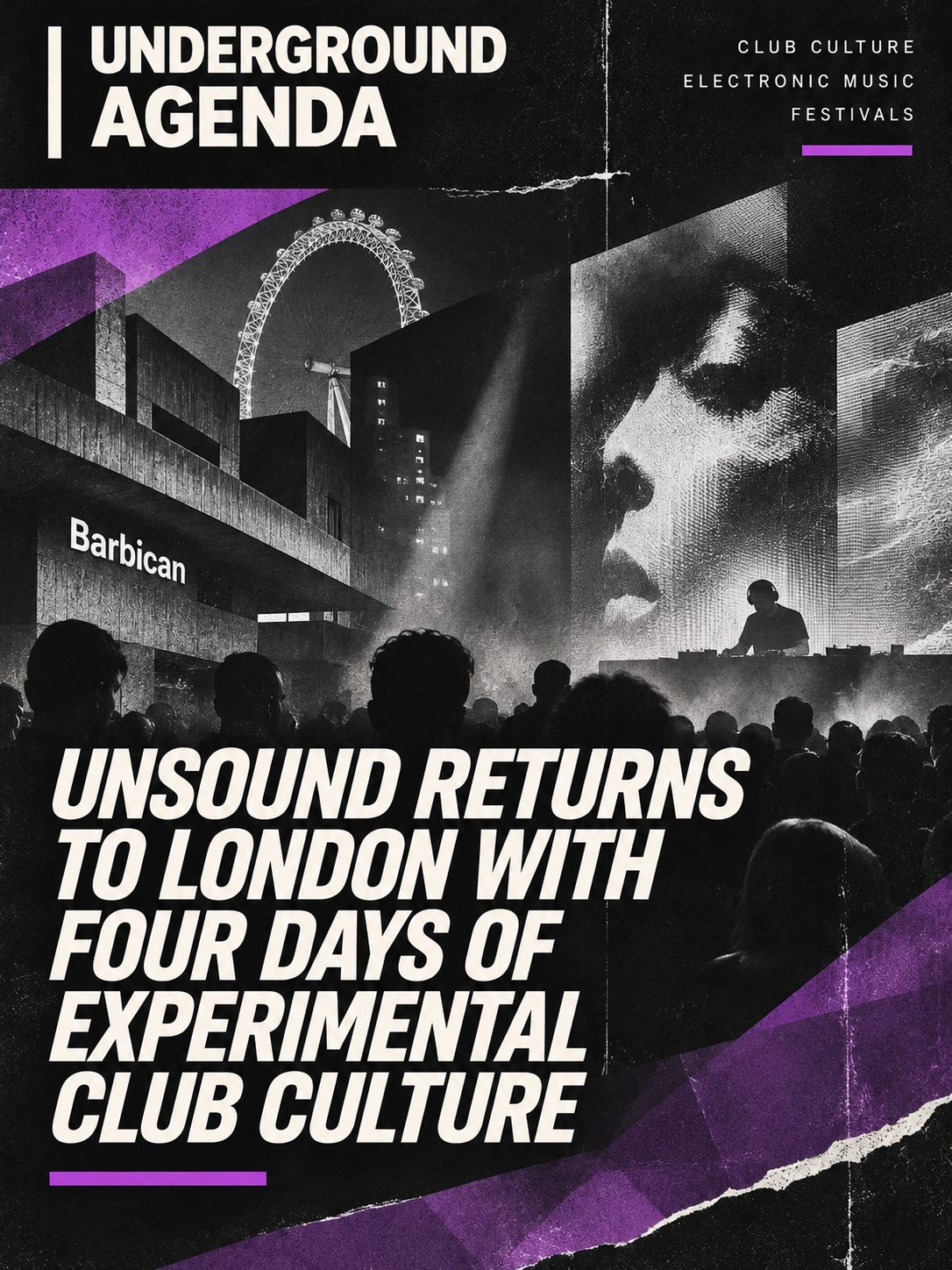
One of Europe’s most adventurous electronic festivals is returning to London with its largest programme in the city in more than a decade.
From November 25 to 28, Unsound London 2026 will spread across several venues including Barbican at Milton Court, the ICA, ORMSIDE Projects and EartH Hackney, bringing together experimental electronics, bass music, contemporary composition, footwork, ambient, club culture and audiovisual performance.
The programme includes artists such as RP Boo, Space Afrika, gyrofield, claire rousay, Martyna Basta, Lorenzo Senni, Anz, Simo Cell, Abdullah Miniawy, Giant Claw, Julek ploski and Visible Cloaks.
But the strength of Unsound has rarely depended on names alone.
The festival is built around collisions.
Genres meet.
Countries meet.
Live music meets club culture.
Old traditions are pulled into contemporary electronic contexts.
That philosophy defines the London edition.
SOFT POWER arrives in London
The 2026 programme continues Unsound’s wider SOFT POWER theme.
The concept already shaped this year’s flagship editions in Poland and now travels to London as part of Unsound’s increasingly international structure.
Rather than treating each city as a completely separate festival, Unsound operates more like a network.
Kraków.
Warsaw.
New York.
London.
Adelaide.
Osaka.
Different cities become temporary laboratories for related ideas.
That model feels particularly relevant today.
Electronic culture has become global.
But the strongest festivals still understand that geography matters.
The same performance means something different in London than in Kraków.
Barbican opens the programme
The festival begins on November 25 at Milton Court, presented with the Barbican Centre.
The opening night features two collaborative projects connecting artists from Poland, the UK and North America.
Los Angeles-based claire rousay performs with Polish composer Martyna Basta, presenting material from hotel room in a cinematic live format with visuals by Theresa Baumgartner.
The same evening also brings together 2K88, Rainy Miller and Bianca Scout.
That project moves through several very different languages.
Polish experimental electronics.
Manchester’s industrial and folk-inflected “Northern Gothic.”
Narrative performance.
Fragments of drill.
The point is not to smooth those differences away.
It is to make them interact.
RP Boo meets Polish folk rhythm
One of the most unusual performances comes the following night at the ICA.
RP Boo, one of the foundational figures in Chicago footwork, will perform with percussionist Gary Gwadera in a project exploring the relationship between Chicago footwork and the Polish folk dance oberek.
Polish folk dancers and London footwork dancers are also involved.
On paper, the connection may appear unexpected.
But rhythm provides the bridge.
Footwork is built around speed, repetition and complex rhythmic interruption.
Oberek is also intensely rhythmic and physically tied to movement.
Unsound’s programming asks what happens when those traditions meet without one simply imitating the other.
This is where the festival remains particularly strong.
It treats club music as part of a much larger history of rhythm.
Lorenzo Senni and the deconstruction of Trance
The same ICA programme includes Lorenzo Senni, presenting a new live show.
Senni has spent years dismantling the language of Trance.
Build-ups without traditional drops.
Synthesizers stretched into abstract structures.
Euphoria treated almost as raw material.
That approach fits perfectly within Unsound.
A sound normally associated with mass dancefloors becomes experimental composition.
The emotional vocabulary survives.
The structure changes.
Medieval music meets modular electronics
Friday introduces another striking collision.
Ukrainian artists Heinali and Andriana-Yaroslava Saienko present the UK debut of their project Гільдеґарда, reworking compositions associated with 12th-century mystic Hildegard von Bingen through modular synthesis, voice and Ukrainian folk influence.
This is not historical reconstruction.
It is translation.
Centuries-old composition enters contemporary electronic technology.
The past becomes raw material for something new.
Giant Claw x Julek ploski
Also at the ICA, Giant Claw joins Polish producer Julek ploski for the audiovisual commission CONTROL FREAK.
Both artists are associated with highly fragmented approaches to digital sound.
Samples collide.
Structures break apart.
Electronic music begins to resemble information overload.
The audiovisual format makes that instability visible.
Again, this is not conventional club programming.
But it emerges from the same technological culture.
ORMSIDE brings the festival back to the dancefloor
Later on Friday, Unsound moves to ORMSIDE Projects for a more explicitly club-oriented programme.
The night is presented with Tropical Waste and includes artists connected to UK bass culture alongside cross-border back-to-back sets between British and Polish selectors.
The choice of ORMSIDE matters.
Unsound can operate inside major cultural institutions.
But it also needs smaller spaces.
Experimental music changes when the audience is standing close to the speakers rather than seated in a concert hall.
The architecture becomes part of the curation.
Space Afrika and gyrofield at EartH
Saturday brings the festival to EartH Hackney.
Manchester duo Space Afrika perform material from Quiet Storm with soprano Nardus Williams and guests.
Elsewhere in the venue, gyrofield presents a new live set.
gyrofield’s work has become increasingly important in conversations around contemporary Drum & Bass and experimental electronic music.
The project moves between precision and abstraction.
Fast rhythms remain.
But they are constantly destabilised.
That is another recurring Unsound characteristic.
Dance genres are present.
They simply are not required to remain in their standard form.
Anz closes the festival
The late programme at EartH concludes with Anz, appearing in a back-to-back with a British artist initially left unannounced in the first programme announcement.
Anz represents another important strand of UK electronic culture.
Garage.
Electro.
House.
Bass.
Rave.
Her selections often move rapidly between these traditions while maintaining a strong dancefloor logic.
After four days of commissioned works, experimental performances and cross-cultural projects, ending with a DJ-driven set makes sense.
Unsound returns to the club.
More than a festival lineup
The London edition contains premieres, commissions, UK debuts and collaborative performances that are unlikely to exist in exactly the same form elsewhere.
That is increasingly rare.
Festival lineups often travel almost unchanged between cities.
The same artists.
The same sets.
The same visual production.
Unsound works differently.
Its value comes partly from creating situations that do not already exist.
That makes curation visible.
London needs this kind of festival
London already has one of the richest electronic scenes in the world.
What Unsound adds is not simply more artists.
It adds connections between scenes that might otherwise remain separated.
Contemporary composition meets club music.
Footwork meets Polish folk rhythm.
Ambient meets performance.
Bass music meets audiovisual art.
Medieval composition meets modular synthesis.
That is the real story of Unsound London.
Not genre diversity for its own sake.
Interaction.
After more than a decade without a London edition at this scale, Unsound returns not by recreating its previous form, but by expanding the idea of what an electronic festival can contain.
UNSOUND LONDON 2026
November 25–28
London, UK
Main venues: Barbican at Milton Court / ICA / ORMSIDE Projects / EartH Hackney
Selected artists: RP Boo / Space Afrika / gyrofield / claire rousay / Martyna Basta / Lorenzo Senni / Anz / Simo Cell / Abdullah Miniawy / Giant Claw / Julek ploski / Visible Cloaks and more.