
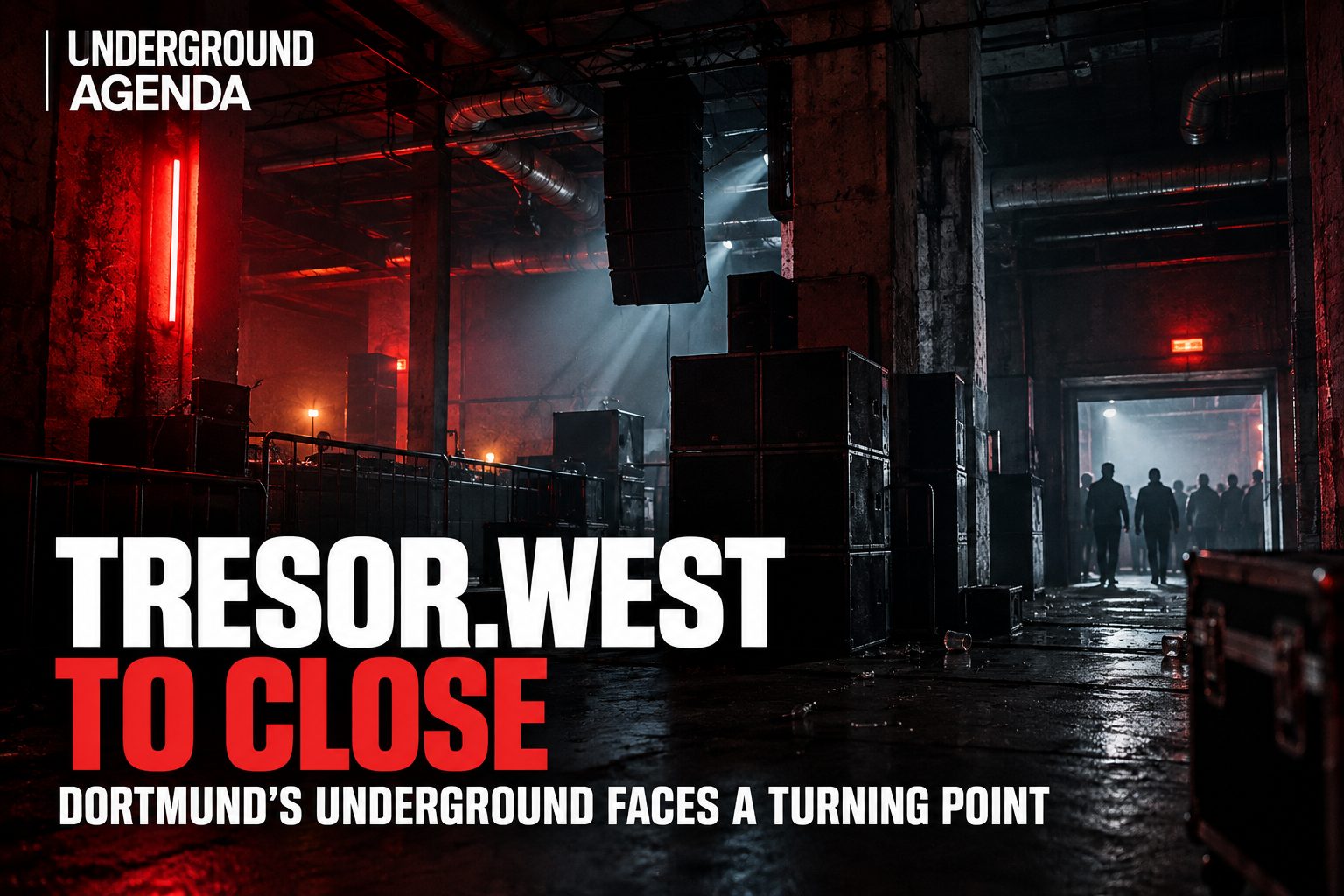
Dortmund is preparing to lose one of its most recognisable electronic music spaces.
Tresor.West has announced that it will close at the end of 2026, bringing the current chapter of the club at Phönixplatz to an end after years spent developing an underground electronic community in Germany’s Ruhr region.
The venue will continue operating through the final months of the year, with closing events scheduled across October, November and December. At the same time, the team is actively looking for a new operator capable of taking over the space and developing a viable future concept for the location.
The reasons behind the decision reflect pressures that extend far beyond a single club.
Operator Dimitri Hegemann pointed to declining visitor numbers, rising operational costs and changing nightlife habits as factors behind the closure. Those conditions have become increasingly familiar across European club culture, where independent venues are being forced to balance higher costs with audiences whose habits have shifted dramatically in recent years.
Tresor.West was never simply another room carrying the Tresor name.
Its significance came from the attempt to translate part of Berlin’s underground philosophy into the Ruhr area without reproducing Berlin itself. Dortmund offered a different industrial history, a different audience and a different local context.
That distinction became central to the identity of the space.
The club developed programming around techno and electronic music while also experimenting with community-oriented concepts. Its Community Nights, for example, moved away from the conventional headline-driven model by offering free entry and focusing attention on local scenes, residents and the social function of the club rather than celebrity billing.
That approach made Tresor.West particularly interesting at a moment when underground venues are increasingly forced to compete with large-scale electronic events.
The closure therefore raises a wider question.
What happens when spaces built around community, long-term cultural development and less commercial programming can no longer sustain themselves economically?
For decades, techno culture has depended on physical spaces that allow scenes to grow before they become commercially visible. Clubs create networks between DJs, promoters, visual artists, technicians and audiences. They provide continuity in a way that temporary events cannot always reproduce.
When one of those spaces disappears, the loss is not measured only in cancelled parties.
It changes the infrastructure of the scene.
The fact that Tresor.West is seeking a new operator leaves the story open. The physical venue may survive under another concept even after the current club operation ends.
But whatever comes next will inherit a difficult question facing nightlife across Europe: how can independent cultural spaces remain sustainable without losing the qualities that made them important in the first place?
Tresor.West still has several months of programming ahead.
Its final season will not simply mark the end of a club.
It will also document another moment in the ongoing transformation of European underground culture, where the survival of the dancefloor increasingly depends on economics, community and the ability of venues to redefine their role.