
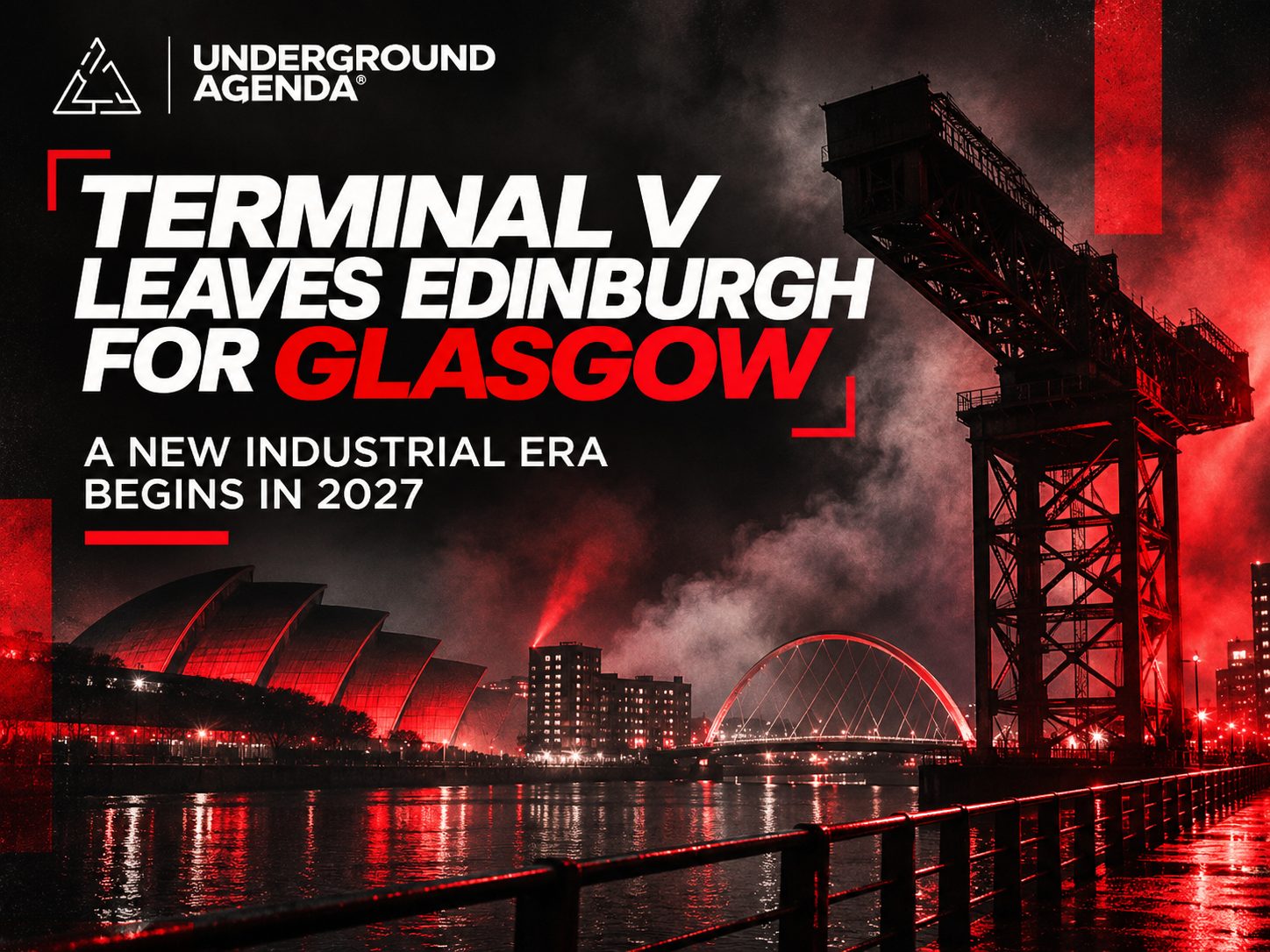
After almost a decade in Edinburgh, one of Scotland's most important electronic festivals is changing city, format and scale.
Terminal V will move to Glasgow in 2027, taking over the new Clydeside Live site on the north bank of the River Clyde from June 4 to 6.
The tenth-anniversary edition will be significant for several reasons.
It will be the festival's first edition in Glasgow.
Its first fully outdoor Scottish edition.
And, for the first time in Terminal V history, the event will run across three days.
For Underground Agenda, the move is interesting because it represents something larger than a change of venue.
A festival built around industrial aesthetics is leaving a familiar indoor complex and attempting to reconstruct its identity from the ground up in Glasgow's docklands.
Ten years after the beginning
Terminal V launched in Scotland in 2017 and gradually became one of the country's most visible electronic events.
The festival says it grew from an event attracting roughly 5,000 people into one of the UK's major electronic festivals, eventually welcoming more than 250,000 attendees across its history at the Royal Highland Centre.
The Royal Highland Centre became almost inseparable from the brand.
Large halls.
Dark interiors.
Industrial staging.
Multiple arenas.
Heavy sound systems.
Thousands of people moving between different interpretations of Techno and electronic music.
That environment helped create Terminal V's identity.
Leaving it is therefore not a small decision.
Goodbye Edinburgh
The 2026 edition marked the end of the Royal Highland Centre chapter.
Terminal V described the departure as the conclusion of almost a decade during which the site hosted artists including Klangkuenstler, Amelie Lens, Charlotte de Witte, Restricted and Azyr.
Festival venues often become invisible once audiences become familiar with them.
But architecture shapes culture.
The Royal Highland Centre allowed Terminal V to create something between a warehouse rave and a major festival.
It was not completely underground.
It was not a conventional outdoor festival either.
The building helped define the middle ground.
Now that structure disappears.
Glasgow becomes the new home
The new location is Clydeside Live, a developing open-air event site in Glasgow's historic docklands.
Terminal V will become the first music festival to occupy the location.
The choice makes sense visually.
Industrial architecture has always been central to Techno culture.
Glasgow's riverfront carries the physical remnants of shipbuilding, engineering and heavy industry.
Instead of recreating industrial imagery through stage decoration, Terminal V can now operate directly inside that landscape.
The city becomes part of the design.
From indoor halls to open sky
The biggest transformation will be environmental.
Terminal V describes the 2027 edition as its first fully outdoor Scottish festival.
That changes almost everything.
Sound travels differently.
Lighting becomes dependent on sunset.
Weather enters the experience.
Stages need completely different production.
Crowds behave differently outdoors.
A Techno event that previously controlled darkness through architecture will now have to create intensity in daylight as well.
That is a major creative challenge.
Three days for the first time
The festival is also expanding from two days to three, running Friday through Sunday.
Three days create another type of festival rhythm.
A one-night rave can sustain constant intensity.
A weekend needs pacing.
A three-day event needs an ecosystem.
People need different sounds.
Different environments.
Moments of pressure.
Moments to recover.
The programming becomes more important because repetition becomes more obvious when audiences remain inside the same musical environment for several days.
More than 100 artists expected
Terminal V previously said that more than 100 artists would be involved in the anniversary edition.
The currently announced programme already spans several parts of contemporary electronic culture.
Artists associated with the lineup include Sara Landry, Helena Hauff, VTSS, Spray, Mall Grab, Interplanetary Criminal, Slam, Restricted, Alarico, Ben Klock, Clara Cuvé, Freddy K, Funk Tribu, Skin On Skin and I Hate Models, among others.
That range is significant.
Terminal V is not presenting one definition of Techno.
Helena Hauff brings machine music
Helena Hauff represents one of the strongest links between Techno, Electro, EBM and analogue machine music.
Her sets often feel deliberately resistant to polished festival structure.
Raw drum machines.
Acid.
Industrial electronics.
Old and new records placed beside each other without smoothing the edges.
Her presence gives the lineup something different from straightforward peak-time Techno.
VTSS and the new club generation
VTSS represents another side of contemporary European club culture.
Her sets can move through Techno, Hard Dance, experimental club music and faster rave sounds.
She belongs to a generation for whom strict genre separation is increasingly irrelevant.
That flexibility is becoming important for festivals.
Audiences no longer necessarily want an entire stage to sound identical for ten hours.
Movement between genres becomes part of the experience.
Spray changes the rhythm
Irish DJ and producer Spray brings a very different energy.
His selections can move through Progressive House, Trance, Techno and deeper club music.
Placing artists like Spray alongside harder names prevents the festival from becoming completely monochromatic.
That contrast is necessary.
Three days of constant maximum-impact Techno would eventually flatten the experience.
Sara Landry and the scale of Hard Techno
Sara Landry reflects another major shift.
Hard Techno is no longer a peripheral underground sound.
It now operates at enormous festival scale.
Her inclusion shows how dramatically the genre's audience has expanded in the last several years.
What once belonged to smaller industrial spaces can now anchor major outdoor stages.
Terminal V's development mirrors that wider transformation.
Interplanetary Criminal and UK club culture
The appearance of Interplanetary Criminal broadens the programme beyond Techno.
His work is deeply connected with UK Garage and contemporary British club music.
This matters because Terminal V increasingly describes itself through the wider electronic landscape rather than one fixed genre.
Glasgow's edition will need that breadth.
Slam brings Glasgow history into the lineup
Perhaps no booking is more geographically appropriate than Slam.
The duo are inseparable from Glasgow's electronic history.
Through Soma Records, club nights and decades of production, Slam helped establish the city as one of Europe's important Techno centres.
Their presence connects Terminal V's arrival with a history that already existed long before the festival moved west.
Terminal V is entering Glasgow.
Glasgow does not need to discover Techno.
Glasgow already has its own electronic identity
This is a crucial distinction.
Moving a large festival into a new city can sometimes feel like importing culture from elsewhere.
That is not what is happening here.
Glasgow already has a deep electronic lineage.
Soma Records.
Sub Club.
Slam.
Optimo.
Numerous independent promoters and generations of DJs.
The challenge for Terminal V is therefore not to introduce electronic music to the city.
It is to find a place within an existing ecosystem.
Area V goes to the water
Terminal V says Area V will be redesigned around a completely new main-stage concept at the water's edge.
That could become one of the defining images of the 2027 festival.
A large Techno stage.
Industrial docklands.
The River Clyde.
Glasgow's skyline.
Instead of hiding the surroundings, the production can use them.
The Hangar without a hangar
Two of Terminal V's most recognisable environments, The Hangar and The Greenhouse, will also be reimagined for the outdoor site.
This raises an interesting question.
How much of a stage's identity comes from its name?
And how much comes from architecture?
The Hangar previously existed as an enclosed environment.
Recreating its intensity outside requires a new visual language.
The 2027 edition will test whether Terminal V's identity can survive without the physical structures that originally created it.
Industrial aesthetics become real geography
Electronic festivals frequently imitate industry.
Scaffolding.
Metal.
Concrete.
Smoke.
Mechanical imagery.
Terminal V's new Glasgow environment already contains much of that visual vocabulary.
The organisers describe Clydeside Live as a natural extension of the festival because of its industrial character.
The danger is obvious.
A real industrial location can easily become just another aesthetic background.
The opportunity is more interesting.
The location can be allowed to remain visible.
A festival changes cities
The economic and cultural implications are also significant.
Terminal V previously estimated that around 30% of its audience travelled from overseas, while the festival contributed millions of pounds to the Scottish economy.
Moving that audience from Edinburgh to Glasgow alters the relationship between the festival and the country.
Hotels.
Transport.
Nightlife.
Afterparties.
Local businesses.
A festival is not confined to its gates.
It changes the city around it for several days.
Ten years becomes a reset
Anniversary editions often look backward.
Archive videos.
Classic artists.
Retrospectives.
Terminal V is using its tenth anniversary differently.
New city.
New site.
New format.
Three days.
Outdoor staging.
The anniversary becomes a reset rather than a museum.
That may be the most interesting decision the festival could have made.
From Edinburgh to the Clyde
Terminal V could have remained at the Royal Highland Centre and continued refining a successful model.
Instead, it is abandoning the environment that helped build its identity.
That creates risk.
It also creates possibility.
For ten years, Terminal V learned how to turn large indoor spaces into electronic environments.
In June 2027, it has to learn how to build one beneath an open sky.
TERMINAL V — 10TH ANNIVERSARY
June 4–6, 2027
Clydeside Live
Glasgow, Scotland
First announced artists include Sara Landry / Helena Hauff / VTSS / Spray / Mall Grab / Interplanetary Criminal / Slam / Restricted / Ben Klock / Alarico / Clara Cuvé / Funk Tribu / Skin On Skin and more.