
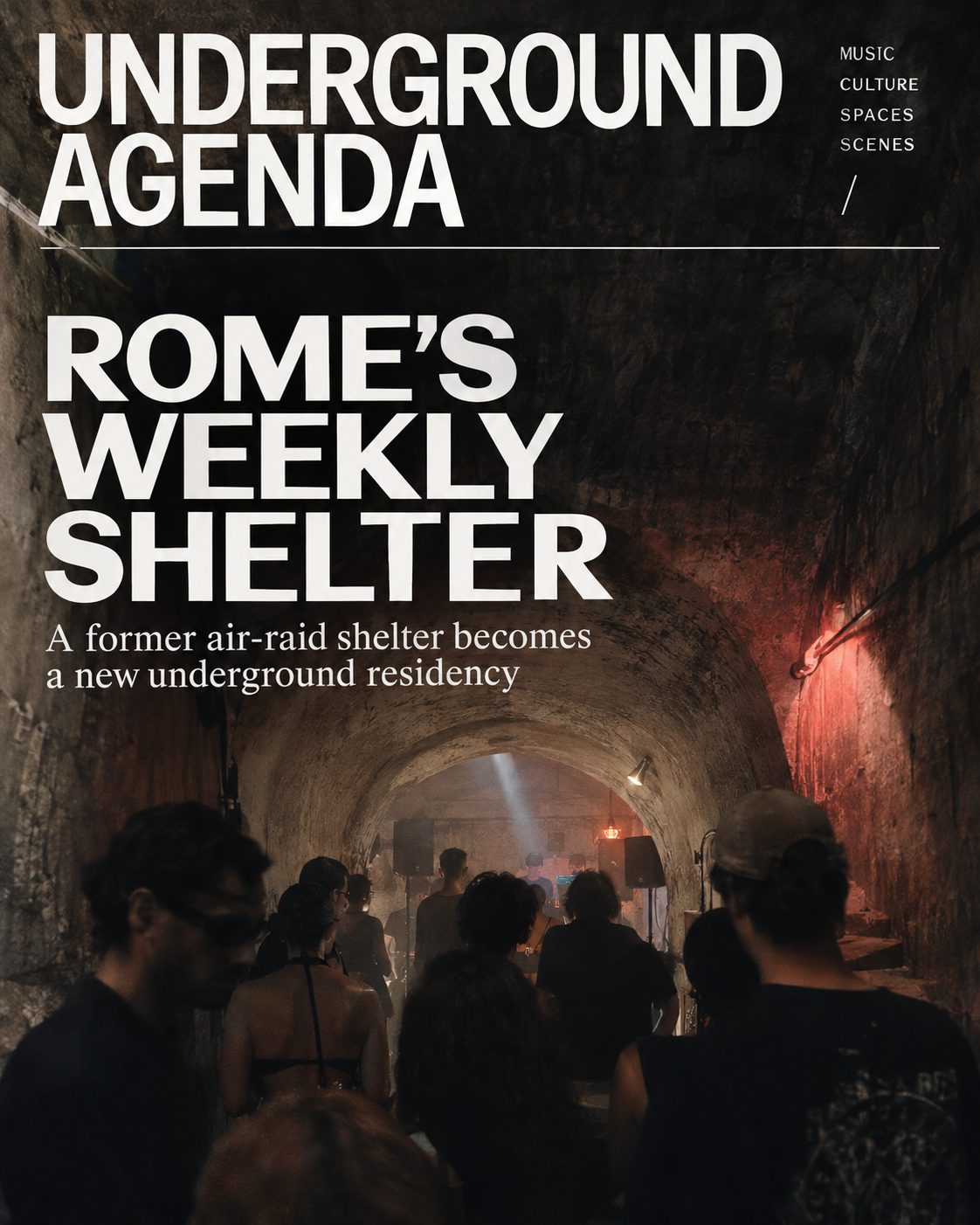
Rome is about to turn one of its most unusual underground spaces into a weekly home for electronic music.
Starting Thursday, November 5, Reveries: Weekly Shelter will launch a new residency inside a former air-raid shelter at the foot of Monte Testaccio, transforming a space once built for protection during wartime into a recurring night for Techno, Bass and underground club culture.
The residency will run every Thursday until December 24, with a different lineup each week built around residents, friends and special guests.
The exact artists will not be announced in advance.
That decision already gives the project a clear identity.
The room comes first.
The community comes second.
The lineup remains deliberately secondary.
A shelter becomes a dancefloor
The location is the strongest part of the concept.
Via di Monte Testaccio sits inside one of Rome’s most historically layered nightlife districts.
The neighbourhood has long contained clubs, bars, cultural spaces and former industrial structures.
But an air-raid shelter introduces a completely different relationship between architecture and electronic music.
This was a space designed for survival.
Enclosed.
Protected.
Hidden.
Now it is being returned to the city through dance.
There is something powerful in that transformation.
Underground music has always had a strong relationship with spaces that were never originally designed as entertainment venues.
Warehouses.
Factories.
Tunnels.
Basements.
Bunkers.
Shelters.
Electronic culture repeatedly discovers new functions inside old architecture.
Reveries continues that tradition.
Every Thursday instead of one spectacular night
The most interesting part of the project may actually be its frequency.
A one-off event can create hype.
A weekly residency creates culture.
Running every Thursday for nearly two months gives Reveries the opportunity to build a recognisable community rather than simply attract an audience for one booking.
The structure is intentionally simple.
Doors at 23:00.
Free entry before midnight.
A different lineup each week.
Music until late.
That repetition matters because scenes are not built through isolated events.
They are built when people know they can return.
Same place.
Same night.
Different music.
Over time, the audience begins to understand the room independently from the lineup.
Secret lineups change the reason people attend
Modern club culture is heavily artist-driven.
Names sell tickets.
Headliners define expectations.
Social media campaigns are often built around the face of the DJ.
Reveries is taking another route.
The lineups will be revealed at the door or close to the event rather than operating as the main promotional engine.
That changes the relationship between audience and promoter.
People have to trust the curatorial identity.
They are not simply buying access to one artist.
They are buying into a recurring space.
This model is difficult to sustain.
But when it works, it can create a stronger scene.
Techno and Bass under Testaccio
Resident Advisor currently categorises the residency under Techno and Bass.
That pairing leaves space for several different directions.
Hypnotic Techno.
Broken rhythms.
Bass-heavy club music.
Experimental electronics.
Industrial textures.
Potentially more leftfield approaches as the residency develops.
The absence of fixed headliners makes that flexibility even more important.
The identity has to come from the curation.
Rome’s underground keeps moving
Rome’s electronic scene has always existed across very different scales.
Historic clubs.
Independent collectives.
Temporary spaces.
Social centres.
New venues.
Smaller weekly formats.
The city does not have one single electronic identity.
That fragmentation can sometimes make the scene difficult to define.
But it also allows new projects to appear in unexpected places.
Reveries fits that pattern perfectly.
An underground residency inside an actual underground structure.
Architecture becomes part of the sound
Rooms influence music.
Low ceilings create pressure.
Concrete reflects sound differently from wood.
Tunnels extend frequencies.
Enclosed architecture changes how bass feels physically.
An air-raid shelter is therefore not a neutral container.
It will shape the way every set is experienced.
For Techno and Bass music, that physical response is especially important.
These genres often depend as much on space as composition.
A kick drum is not simply heard.
It is felt through architecture.
From refuge to collective space
There is also a symbolic layer that cannot be ignored.
A shelter once existed because people needed somewhere to escape danger.
Now the same type of architecture becomes a place where people choose to gather.
The function changes completely.
Fear becomes community.
Silence becomes sound.
Isolation becomes collective movement.
Reveries does not need to turn that history into a marketing slogan.
The building already contains the meaning.
A residency worth watching
The first Weekly Shelter takes place tomorrow, November 5.
The lineup remains unknown.
That is part of the idea.
For Underground Agenda, the story is not really about who plays first.
It is about what happens if Rome can turn this space into a recurring underground institution.
One Thursday will not answer that.
Eight weeks might.
REVERIES: WEEKLY SHELTER
Every Thursday, November 5 – December 24, 2026
23:00 – late
Via di Monte Testaccio 67
Rome
Techno / Bass
Free entry before midnight
Different lineup every week.