
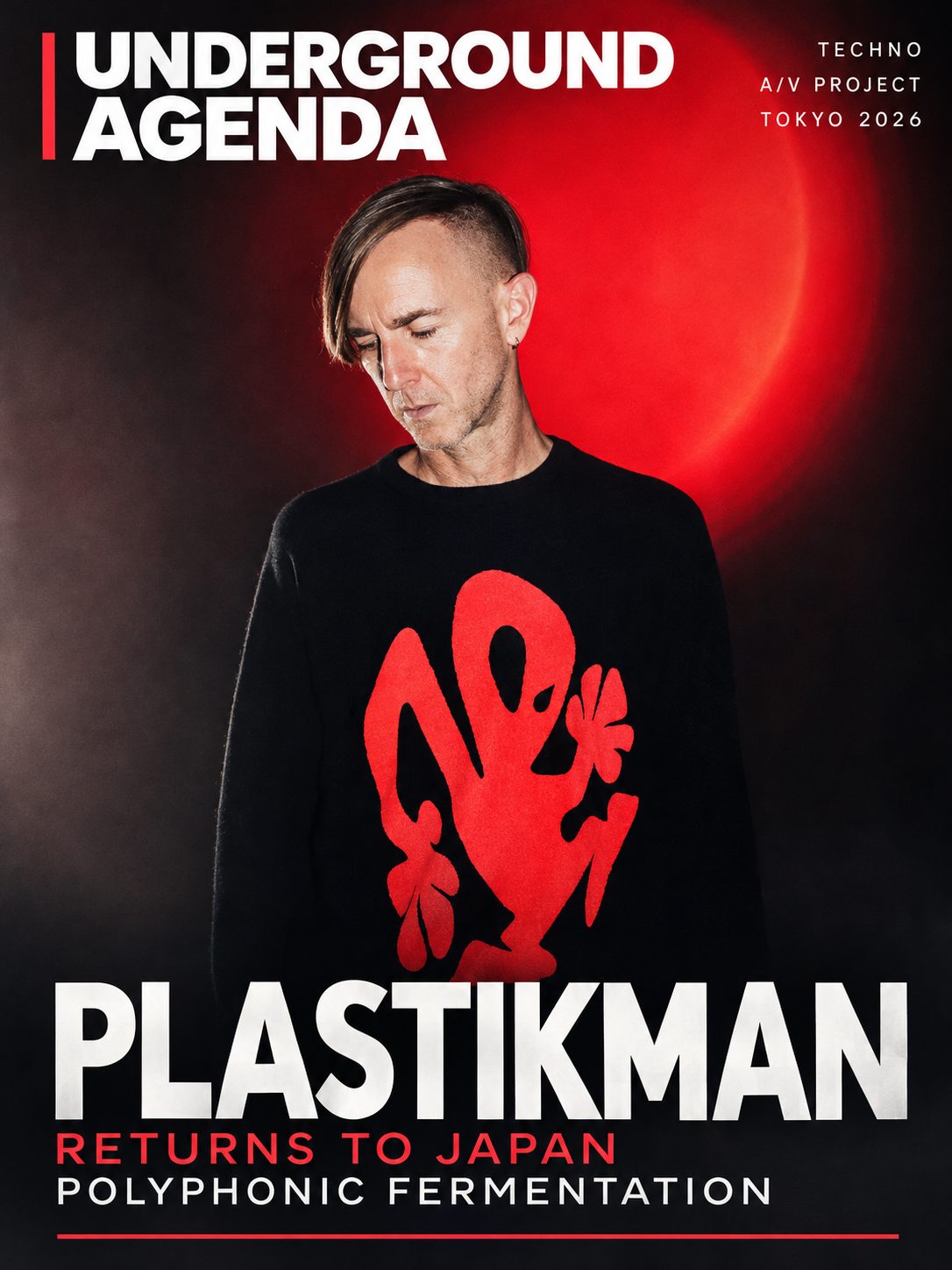
Richie Hawtin is bringing Plastikman back to Japan for the first time in sixteen years.
But this will not be a conventional live return.
On November 23, 2026, Hawtin and longtime visual collaborator Ali Demirel will premiere PLASTIKMAN | POLYPHONIC FERMENTATION at MUTEK.JP in Tokyo, an audiovisual project created from field recordings, images and ideas collected inside Japanese sake breweries.
The world premiere will close MUTEK.JP 2026 at MoN Takanawa, where the project will exist in two forms: a one-night performance inside Box1000 and an installation remaining open in the museum's Tatami space until December 27.
For Underground Agenda, this is one of the most interesting electronic projects of the month precisely because it is difficult to categorise.
It is Techno.
Installation art.
Documentary recording.
Japanese cultural research.
And a new Plastikman work built around something almost invisible:
fermentation.
Plastikman without the conventional Plastikman show
Plastikman occupies a particular place in electronic music history.
Richie Hawtin created the alias in the early 1990s, developing a minimal form of Acid Techno that reduced electronic music to some of its most essential components.
Bass.
Space.
Repetition.
The Roland TB-303.
Silence used almost as another instrument.
Albums such as Sheet One, Musik and Consumed helped establish an aesthetic that influenced generations of Minimal and Techno producers.
More than three decades later, Hawtin could easily use the Plastikman name to recreate that history.
Polyphonic Fermentation does the opposite.
MUTEK explicitly describes the project as not a conventional Plastikman live show, but a bespoke work developed specifically by Hawtin and Demirel around Japanese sake culture and the process of fermentation.
That distinction matters.
The project uses a historic electronic identity to explore something new rather than simply reproduce its catalogue.
Inside the breweries
The material began with travel.
In April 2026, Hawtin and Demirel visited sake breweries in different parts of Japan, including Gekkeikan in Kyoto, Aramasa in Akita and Yoshida Sake Brewery in Ishikawa.
There they recorded images and sounds from the production process.
Machines.
Rooms.
Liquid.
Rice.
Human activity.
The almost imperceptible biological transformation taking place inside the vessels.
Those recordings were then developed into the audiovisual material behind Polyphonic Fermentation.
This is important because the sounds are not simply decorative samples placed into a Techno track.
The production process itself becomes the conceptual architecture of the work.
What does fermentation have to do with Techno?
More than it initially appears.
Fermentation is based on transformation through repetition and time.
At any individual moment, very little appears to happen.
But over hours, days and weeks, the material changes completely.
Minimal electronic music often operates through a similar perception.
A loop repeats.
Then something moves.
A frequency changes.
A rhythm disappears.
A sound enters almost invisibly.
Twenty minutes later, the musical environment feels completely different even though no dramatic transition occurred.
Hawtin and Demirel explicitly connect the project with the Japanese concept of utsuroi, the sensitivity toward gradual, continuous change.
That makes fermentation more than the subject.
It becomes a compositional model.
Multiple parallel fermentation
The title itself comes from sake production.
Sake uses what is known as multiple parallel fermentation, where different biological processes happen simultaneously in the same vessel.
Koji converts rice starch into sugar while yeast transforms those sugars into alcohol.
Different transformations coexist.
Polyphonic Fermentation translates that principle into sound and image.
Audio.
Video.
Electronic synthesis.
Documentary material.
Cultural history.
Technology.
None of those elements needs to exist separately.
They ferment together.
Ali Demirel and the visual language of Plastikman
Ali Demirel's involvement is fundamental.
The Turkish visual artist has collaborated extensively with Hawtin, helping define the visual environments surrounding several of his projects.
Electronic music performance has increasingly become audiovisual.
But there is an important difference between adding visuals behind a DJ and creating an image system that develops structurally with sound.
Polyphonic Fermentation is designed around the second model.
Footage captured inside the breweries becomes abstracted.
Details become landscapes.
Liquids become textures.
Micro-scale biological processes become enormous visual environments.
The installation at MoN Takanawa is described as deliberately slow and meditative, using macro imagery and gradual transformation to express the same concept of imperceptible change.
One performance, five weeks of installation
The project is also unusual because it operates across two completely different timescales.
The live performance happens once, on November 23.
Doors open at 17:00.
The performance begins at 18:00.
The programme ends at 20:00.
The installation, meanwhile, remains accessible through December 27.
That contrast reflects the concept perfectly.
The live show is immediate.
The installation develops through repeated viewing.
One belongs to performance culture.
The other belongs closer to museum time.
The same artistic material changes depending on how long the audience stays with it.
Plastikman returns after sixteen years
The performance is also historically significant.
MUTEK confirms that it will be the first performance carrying the Plastikman name in Japan in sixteen years.
For a country that has played an important role in Hawtin's personal and professional life, the return feels deliberately specific.
Japan is not simply another tour stop.
Hawtin has been involved with Japanese sake culture for nearly two decades, making this project a convergence of two long-running interests rather than a temporary thematic experiment.
Electronic music and sake are being brought together because both already exist inside his life.
November 23 is not a random date
The premiere takes place on Niiname-sai, Japan's traditional harvest festival, now also observed as Labor Thanksgiving Day.
The date historically connects rice, harvest and gratitude.
For a project based on sake fermentation, choosing November 23 adds another layer of context.
This kind of detail matters.
Electronic performances often operate as if they exist outside history and geography.
A dark room could theoretically be anywhere.
Polyphonic Fermentation is intentionally impossible to separate from Japan.
The breweries.
The rice.
The date.
The museum.
The process.
The location is part of the work.
MUTEK.JP expands the context
Polyphonic Fermentation closes the eleventh edition of MUTEK.JP, running from November 20 to 23.
More than 30 artists and projects are involved across electronic music, audiovisual work and digital creativity.
The wider programme includes Max Cooper, Hania Rani, Ryoichi Kurokawa, Daito Manabe x ELEVENPLAY, Grand River, mouse on the keys, Robert Lippok & Lucas Gutierrez and NEUROSCAN, among others.
That programming gives the Plastikman premiere the correct context.
MUTEK has historically positioned electronic sound as more than nightlife.
Music technology.
Digital art.
Installation.
Performance.
Research.
These practices meet inside the same festival.
Techno outside the nightclub
This may be the most interesting aspect of the project.
Techno is often discussed through venues.
Berghain.
Tresor.
Detroit warehouses.
Festivals.
Dancefloors.
Polyphonic Fermentation asks what happens when the same electronic language enters another environment entirely.
A museum.
A tatami room.
A sake brewery.
The sound is no longer required to create peak-time energy.
It can describe process.
Time.
Matter.
Transformation.
That does not make the project less connected to Techno.
It returns to something fundamental within the genre.
Technology as a way of perceiving the world differently.
From machine music to organic systems
Early Techno was often imagined through machines.
Factories.
Robotics.
Computers.
Automation.
Futurism.
Here, Plastikman turns toward microorganisms.
Fermentation is technology too.
It is simply biological technology.
Yeast transforms matter.
Koji transforms matter.
Time transforms matter.
Instead of the machine replacing the organic world, technology becomes a way of observing it.
That shift makes Polyphonic Fermentation particularly interesting within Hawtin's career.
The artist once associated with extreme electronic reduction is now examining microscopic biological complexity.
Plastikman keeps changing
There is a temptation with historically important electronic projects to preserve them exactly as audiences remember them.
Play the famous record.
Use the famous sound.
Repeat the image.
Plastikman has always been more interesting when it resists that approach.
PLASTIKMAN | POLYPHONIC FERMENTATION does not ask audiences to return to 1993.
It asks them to listen to fermentation in 2026.
The acid machine has become a sake brewery.
The repetition remains.
The transformation continues.
And after sixteen years, Plastikman returns to Japan not by looking backward, but by finding another process capable of turning time into sound.
PLASTIKMAN | POLYPHONIC FERMENTATION
Richie Hawtin & Ali Demirel
World Premiere
November 23, 2026
18:00
Box1000 — MoN Takanawa
Tokyo, Japan
Installation: November 23 – December 27, 2026, Tatami at MoN Takanawa.