
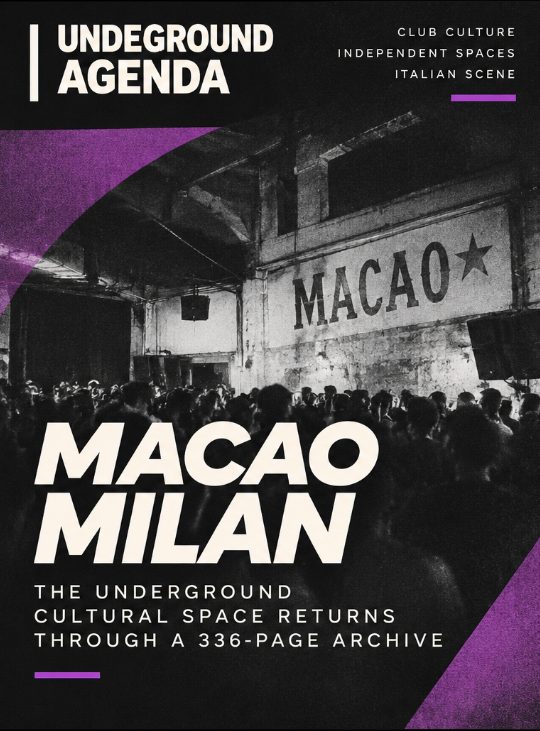
Milan is about to recover one of the most important chapters of its recent underground history.
On December 14, 2026, Nero Editions will release Archiving the Ungovernable, a 336-page book dedicated to Macao, the independent cultural project that spent almost a decade connecting electronic music, art, political assembly and self-organised culture in the city.
The volume gathers photographs, posters, manifestos, essays, statements and internal notes assembled by people from different generations of the Macao community. (neroeditions.com)
For Underground Agenda, the importance of this release goes beyond nostalgia.
Macao was never simply a nightclub.
It was an attempt to build another model of cultural space.
It began with an occupation
The story started on May 5, 2012.
A group of artists and cultural workers occupied Torre Galfa, an abandoned skyscraper in Milan, and created what they described as a new centre for arts, culture and research.
Thousands of people entered the building during its first days, turning the occupation into a highly visible cultural event. Academic research later identified Macao as part of a wider Italian wave of cultural occupations and bottom-up artistic activism that developed during the early 2010s. (air.unimi.it)
The project was founded by people connected to Lavoratori dell’Arte, a network of artists, critics, curators, journalists and cultural workers questioning the economic and political structures surrounding creative labour.
The objective was larger than securing a venue.
It was about asking who controls cultural space.
From Torre Galfa to the former slaughterhouse
Macao did not remain in Torre Galfa.
After a series of moves and confrontations around different locations, the project eventually settled in the former slaughterhouse complex at Viale Molise 68.
That building became its most recognisable home.
A large post-industrial space.
Part art centre.
Part political assembly.
Part club.
Part laboratory.
Part social infrastructure.
Independent cultural projects often claim to combine different disciplines.
Macao actually did it.
Electronic music became central
Music was not the only activity taking place inside Macao, but it became one of the most visible.
Resident Advisor describes the space as an essential hub for Milan’s underground and experimental scene, hosting events including Dance Affliction and the Saturnalia festival. (ra.co)
The importance of those nights came partly from context.
The music was not presented inside a conventional commercial venue.
The dancefloor existed inside a wider political and cultural project.
That changes the meaning of a party.
Buying a ticket was not simply consuming nightlife.
It helped sustain a shared space.
Dance Affliction
Dance Affliction became one of the recurring projects most strongly associated with Macao’s club identity.
The night reflected a particular strand of European underground culture where experimental electronics, Techno, House and less easily classified sounds could coexist.
This was never a space built around predictable headliners.
The curatorial logic was often more important than the individual artist name.
That allowed Macao to operate as a discovery platform.
Local DJs could appear alongside international experimental artists.
Club music could sit next to performance.
The boundary between nightlife and cultural programming remained intentionally unstable.
Saturnalia
The Saturnalia festival pushed that approach further.
Rather than behaving like a conventional festival built around large stages and fixed genre categories, Saturnalia used Macao’s architecture to create several overlapping experiences.
Electronic music.
Live performance.
Art.
Installations.
Discussion.
The project became one of the clearest demonstrations of what Macao could do when its different identities operated simultaneously.
A cultural centre became a festival.
A political space became a dancefloor.
An abandoned building became infrastructure.
Self-management as part of the culture
The internal structure was as important as the artistic programme.
Macao was collectively managed.
Decisions were made through assemblies.
Different working groups dealt with programming, maintenance, communication and the wider political direction of the project.
This model created complications.
Consensus is slow.
Collective governance is messy.
Responsibility becomes distributed.
But that complexity was part of the experiment.
The organisation was not trying to imitate a conventional club company.
It was attempting to create another way of producing culture.
The battle over the building
The relationship with the property itself remained unstable throughout Macao’s history.
In 2017, the collective attempted to purchase the building and formalise its presence there.
The project also sought recognition within Milan’s institutional cultural system while trying to protect its autonomous structure. (ra.co)
That tension is central to many independent spaces.
Autonomy provides freedom.
Legal recognition provides stability.
The two do not always coexist easily.
For Macao, the attempt to move from occupation toward a more permanent model became part of a larger debate about ownership, commons and the right to use urban space.
Culture versus real estate
Macao existed inside one of Europe’s wealthiest and most rapidly transforming cities.
Milan increasingly positioned itself through fashion, design, real estate and international investment.
Independent culture occupied a more precarious position.
Academic researchers studying Macao described the project as a challenge to the traditional “creative city” model, where culture is valued primarily when it contributes to economic growth and urban branding. (sciencedirect.com)
Macao asked another question.
Can culture have value even when it refuses to behave like a conventional economic asset?
The end of Viale Molise
The physical space eventually closed in 2021.
After nine years, Macao suspended its activities at Viale Molise amid increasingly difficult conditions around the building and surrounding area.
The collective described the move as an “arrivederci” rather than a definitive end. (lastampa.it)
But the closure created an obvious problem.
What happens to the knowledge generated inside a space when the space disappears?
Archiving the Ungovernable
That question sits at the centre of the new book.
Archiving the Ungovernable does not attempt to produce a perfectly linear institutional history.
Nero Editions describes it as a collective archive assembled through images, manifestos, essays, statements and notes contributed by people who participated in different generations and working groups of Macao. (neroeditions.com)
The title itself explains the contradiction.
Archives organise.
Macao resisted conventional organisation.
The challenge is therefore to document a project whose identity was constantly changing.
336 pages of collective memory
The volume runs to 336 pages in a 21 x 28 cm format and is published in English.
It traces Macao’s history from the formation of Lavoratori dell’Arte and the Torre Galfa occupation through the years at Viale Molise. (neroeditions.com)
It also places the project inside a wider network.
Isola Art Center.
Teatro Valle Occupato in Rome.
Sale Docks in Venice.
The Occupy movement.
The Italian referendum movement around public water.
Macao was never isolated.
It belonged to a larger historical moment when cultural workers across Europe were questioning ownership, labour and access to space.
Why archives matter to club culture
Nightlife has a memory problem.
Clubs close.
Flyers disappear.
Social media accounts are deleted.
Hard drives fail.
The people who organised events move on.
A scene that once felt enormous can become almost invisible within a decade.
This is particularly true for independent spaces.
Commercial venues leave company records.
Large festivals produce professional documentation.
Autonomous projects often survive through personal archives.
Photos.
Messages.
Posters.
Stories.
Macao’s book attempts to prevent that disappearance.
The dancefloor as political memory
This matters to electronic music because club history is rarely only about music.
The location matters.
Who owned the building matters.
Who controlled the door matters.
Who could afford entry matters.
Who programmed the artists matters.
How the workers were treated matters.
Macao made those questions explicit.
The party and the political assembly existed at the same address.
They were not separate worlds.
Can a book replace a space?
No.
A book cannot reproduce a room at 4 AM.
It cannot recreate the sound system.
It cannot recreate the social relationships created through years of repeated gatherings.
But it can preserve methods.
Ideas.
Failures.
Experiments.
Images.
Language.
And those things can travel.
That may ultimately be the most important function of Archiving the Ungovernable.
Macao no longer exists in the form it had between 2012 and 2021.
But its archive can still influence the next collective attempting to create something outside conventional nightlife.
The building disappeared.
The knowledge does not have to.
ARCHIVING THE UNGOVERNABLE
MACAO
Nero Editions
336 pages
Release: December 14, 2026
Price: €30. (neroeditions.com)