
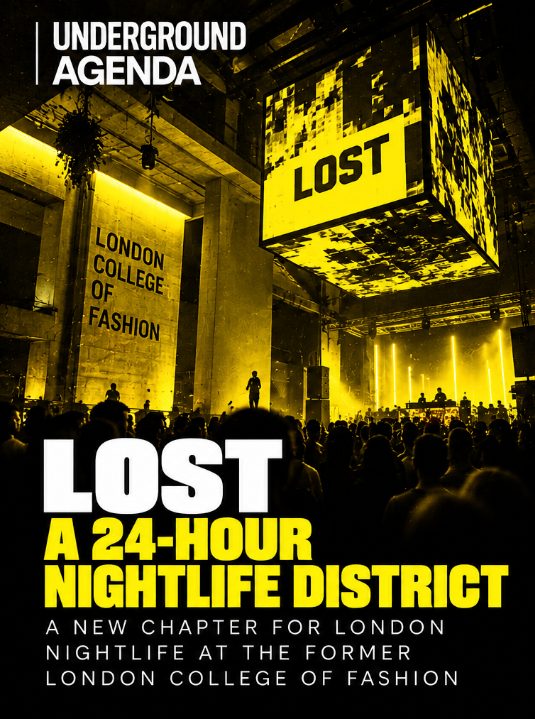
London nightlife may be about to get one of its most ambitious new spaces.
Lost has secured the former London College of Fashion complex on Oxford Street and is seeking a licence that would allow the project to operate as a 24-hour cultural and nightlife district in the heart of the city.
The announcement marks the next chapter for a project that has built much of its identity around secrecy, phone-free dancefloors and temporary occupation of unusual Central London buildings.
Lost left its former home inside the disused Odeon cinema on Shaftesbury Avenue in May after its temporary licence expired. Five months later, the team has confirmed plans to take over an entire former university block on Oxford Street.
The scale alone makes the project notable.
But the more interesting question is what Lost wants to do with it.
From secret club to 24-hour district
Lost has described the new site as more than another nightclub.
Its recent communication refers to a “24-hour district” and a space dedicated to new forms of nightlife, culture and art.
The project is currently asking its community to support its application for a premises licence from Westminster Council.
That wording suggests an attempt to move beyond the traditional club model.
A single dancefloor has fixed opening hours.
A cultural district can potentially contain several spaces operating differently throughout the day and night.
Lost’s previous location already hinted at this approach.
Inside the former cinema, the project combined club rooms with screenings, live performances and hidden bars. Its no-phone policy and secret lineups helped create a sense that the venue itself was more important than the list of artists playing inside it.
The Oxford Street site gives that idea much more room.
No phones, no lineup
Lost’s refusal to build its identity around announced headliners is unusual in contemporary nightlife.
Most large club campaigns begin with the lineup.
Artist names drive ticket sales, social media and audience expectations.
Lost has worked in the opposite direction.
“No phones. No line-up.”
That has effectively become part of the project’s philosophy.
Removing phones changes the dancefloor.
Removing the lineup changes the reason people enter the building.
The audience has to trust the venue itself.
That can create a stronger form of club identity, because the relationship is no longer between a crowd and one headline DJ.
It is between a crowd and a space.
Oxford Street as an underground location
The location creates another contradiction.
Oxford Street is one of the most commercial areas in London.
It is associated with retail, tourism and daytime movement rather than underground electronic culture.
Placing an experimental 24-hour nightlife concept inside a former fashion college there reverses the usual logic of club geography.
Underground venues often move toward industrial districts, warehouses and peripheral areas because central urban space is expensive and heavily regulated.
Lost is attempting the opposite.
It wants to bring alternative nightlife directly into the commercial centre of London.
That makes the licensing battle especially important.
The politics of nightlife
The project arrives during an increasingly difficult period for Central London nightlife.
Westminster Council has faced criticism over proposed licensing changes that could restrict the creation of new nightlife venues in parts of the West End.
London Mayor Sadiq Khan has criticised aspects of those proposals, while Westminster has argued that tighter controls are necessary because of policing and alcohol-related concerns.
Lost therefore becomes part of a wider argument.
What should a city centre be allowed to become after dark?
Retail district?
Residential area?
Entertainment zone?
Cultural space?
Nightlife is often treated as temporary or secondary compared with offices, housing and retail.
A 24-hour district challenges that hierarchy.
It argues that nightlife itself can be infrastructure.
Temporary spaces and permanent communities
Lost’s history is based partly on temporary occupation.
That gives the project flexibility.
But temporary spaces also create instability.
Every successful club culture eventually faces the question of permanence.
Can a community remain strong when its physical home disappears every few months?
The new Oxford Street project could provide an answer.
If the licence is approved and Lost can establish a longer-term base, it may become something closer to a cultural institution than a secret party.
But that transition also carries risk.
Part of Lost’s appeal came from uncertainty.
Mystery.
Temporary architecture.
The feeling that the room might disappear.
A permanent home changes that relationship.
A test for London nightlife
Lost has not yet announced a confirmed opening date for the Oxford Street site.
The team had previously suggested a November return, but the latest update focuses on securing the licence rather than confirming when the doors will open.
That means the project remains unfinished.
But perhaps that is appropriate.
Lost has always built its identity around spaces in transition.
A cinema became a club.
Now a fashion college may become a 24-hour cultural district.
The building changes.
The question remains the same.
Can central London still make room for nightlife that does not behave like conventional nightlife?
Lost is about to find out.