
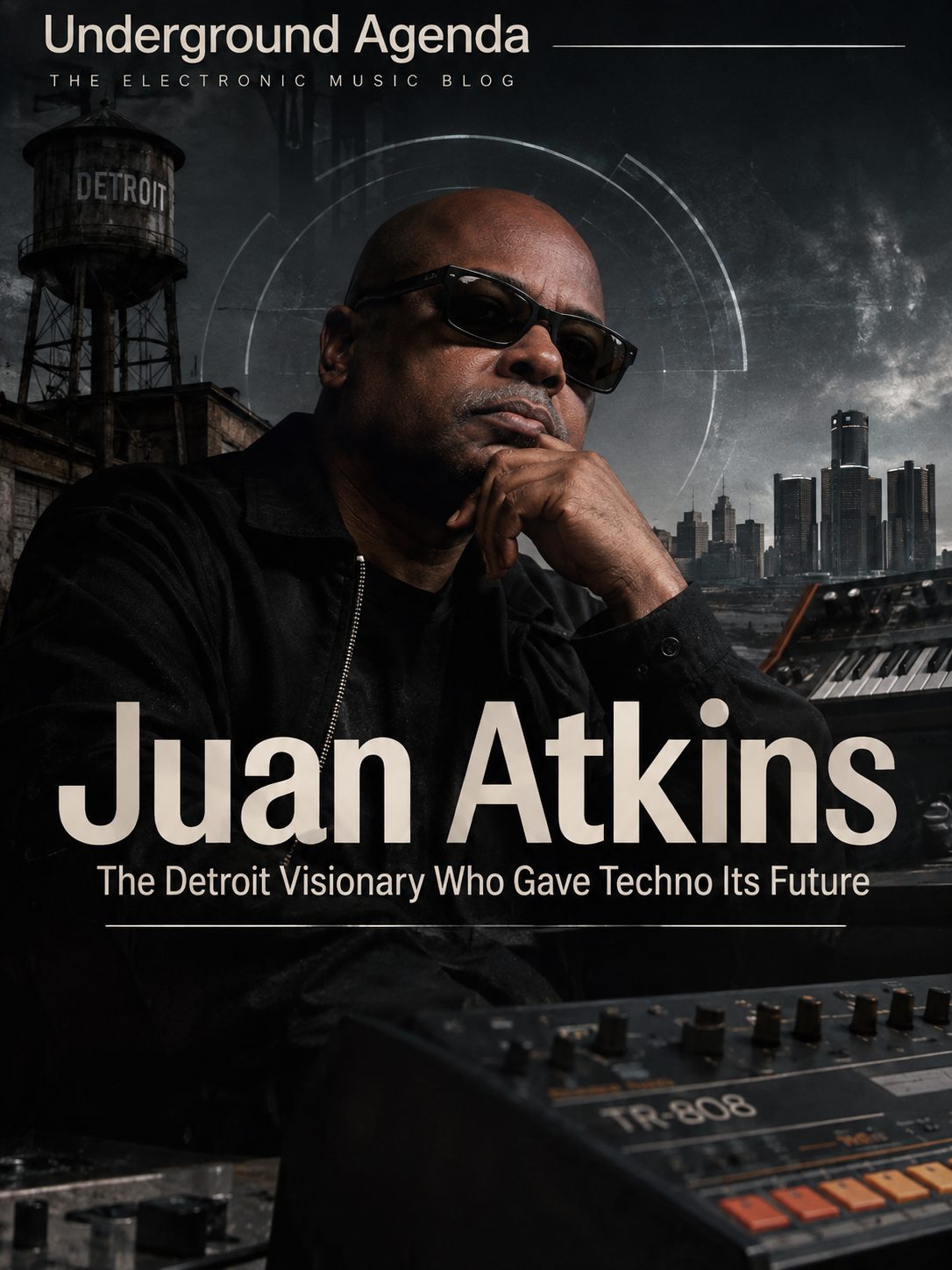
Electronic music has lost one of the architects of its future.
Juan Atkins, the Detroit producer, DJ and composer widely regarded as one of the founding figures of Techno, has died at the age of 64.
His management company, Greensmith Artists, confirmed the news on November 1. Resident Advisor reported that Atkins had been found unresponsive in his hotel room in Mexico City ahead of a scheduled performance and was later pronounced dead. (ra.co)
For underground electronic culture, Atkins’ importance is difficult to overstate.
This is not simply the story of an influential DJ.
It is the story of an artist who helped create an entirely new language.
Before Techno had a name
Juan Atkins was born in Detroit in 1962 and later moved to nearby Belleville.
There he met Derrick May and Kevin Saunderson, the two artists with whom he would eventually become known as the Belleville Three. (pitchfork.com)
The three grew up surrounded by a strange combination of influences.
Detroit’s industrial environment.
Funk.
European electronic music.
Radio.
Science fiction.
Machines.
The future.
Atkins absorbed all of it.
The music that eventually emerged did not sound entirely like Disco.
It was not Funk.
It was not Electro as people understood it at the time.
It was something new.
Cybotron and the machine
At only 18, Atkins formed Cybotron with Richard “3070” Davis.
Early tracks including “Alleys of Your Mind,” “Cosmic Cars” and “Clear” began to establish the sonic vocabulary that would later become fundamental to Techno. (pitchfork.com)
Synthesizers.
Drum machines.
Robotic rhythm.
Futuristic imagery.
But underneath all the technology remained something deeply human.
That contradiction became one of Atkins’ greatest strengths.
Machines were not used to remove emotion.
They were used to create another type of emotion.
“Clear” travels far beyond Detroit
Released in 1983, Cybotron’s “Clear” became one of the defining electronic tracks of its era.
Its influence extended far beyond the Detroit scene.
Decades later, the record would be sampled prominently in Missy Elliott’s “Lose Control,” demonstrating how the language developed inside early Detroit electronic music eventually entered mainstream American culture. (theguardian.com)
That journey mirrors the larger history of Techno.
A sound born inside a specific Black American environment eventually travelled around the world.
Model 500 and the birth of Detroit Techno
After leaving Cybotron, Atkins began releasing music as Model 500.
Tracks such as “No UFO’s” and “The Chase” helped define the sound that would soon be internationally recognised as Detroit Techno. (theguardian.com)
In 1985, Atkins also founded Metroplex Records.
The label became another crucial part of Detroit’s electronic infrastructure.
It gave the music somewhere to exist independently.
That matters.
Genres do not grow through artists alone.
They require labels.
Record shops.
Radio.
Clubs.
Distribution.
Communities.
Metroplex became part of that ecosystem.
Why “Techno” mattered
Atkins also played a central role in establishing the word itself.
His artistic philosophy was strongly influenced by futurist ideas, particularly the writings of Alvin Toffler.
Technology was not simply equipment.
It was a way of thinking about society.
Detroit provided the perfect environment for that perspective.
The city was simultaneously a symbol of industrial power and industrial decline.
Factories represented progress.
Automation also represented jobs disappearing.
Technology could build the future.
It could also destroy the structures that came before it.
Atkins understood both sides.
That tension entered the music. (theguardian.com)
Detroit imagined the future differently
Techno is sometimes presented today primarily through European imagery.
Berlin warehouses.
Concrete.
Industrial darkness.
Huge festivals.
But the roots of the genre are Black and American.
Detroit created the original language.
Atkins, May and Saunderson imagined electronic music through the specific reality of a city shaped by the automobile industry, racial politics, economic transformation and technological change.
The future in Detroit Techno was never purely optimistic.
It contained both possibility and anxiety.
That gave the music depth.
From Detroit to Berlin
The sound eventually crossed the Atlantic.
After the fall of the Berlin Wall, Techno became part of the cultural reconstruction of a divided city.
Abandoned buildings became clubs.
Detroit records travelled through European record shops and DJ booths.
The connection between Detroit and Berlin became one of the strongest transatlantic relationships in electronic music.
Juan Atkins was one of the artists responsible for making that possible.
Without Detroit, there is no Berlin Techno as we understand it today.
Beyond Model 500
Atkins continued producing under several identities throughout his career.
Model 500 remained the best known.
But he also released music as Infiniti and later collaborated with Moritz von Oswald through Borderland.
That project created a direct dialogue between Detroit Techno and Berlin’s dub-influenced electronic tradition.
It was almost symbolic.
Two cities.
Two histories.
One electronic language.
Cybotron returns
Atkins never treated his early work as something frozen in history.
In 2023, he revived Cybotron, bringing the project back into contemporary performance culture decades after its original formation. (theguardian.com)
That decision says something important about his relationship with the past.
The music was historical.
But it was never supposed to become a museum piece.
It remained functional.
Electronic.
Alive.
Techno before spectacle
The modern Techno industry is enormous.
Festivals.
Arena shows.
Global touring.
Fashion.
Brand collaborations.
Millions of social-media clips.
Atkins came from another world.
A world where electronic music was still an experiment.
There was no global Techno industry to enter.
No algorithmic genre category.
No template.
The artists had to invent the vocabulary themselves.
That is what separates pioneers from successful performers.
A successful artist works inside a language.
A pioneer helps create the language.
Juan Atkins did exactly that.
The human inside the machine
Perhaps the most important part of his legacy is the idea that futuristic music does not need to be emotionally cold.
Atkins used synthesizers and drum machines to imagine what might come next.
But the objective was never technology for technology’s sake.
The machines remained tools.
The purpose was expression.
That philosophy still survives in the best electronic music today.
A synthesizer is not futuristic because it is electronic.
It becomes futuristic when an artist uses it to imagine something that does not yet exist.
Juan Atkins spent more than four decades doing exactly that.
Detroit gave Techno a city.
Juan Atkins gave it a future.