
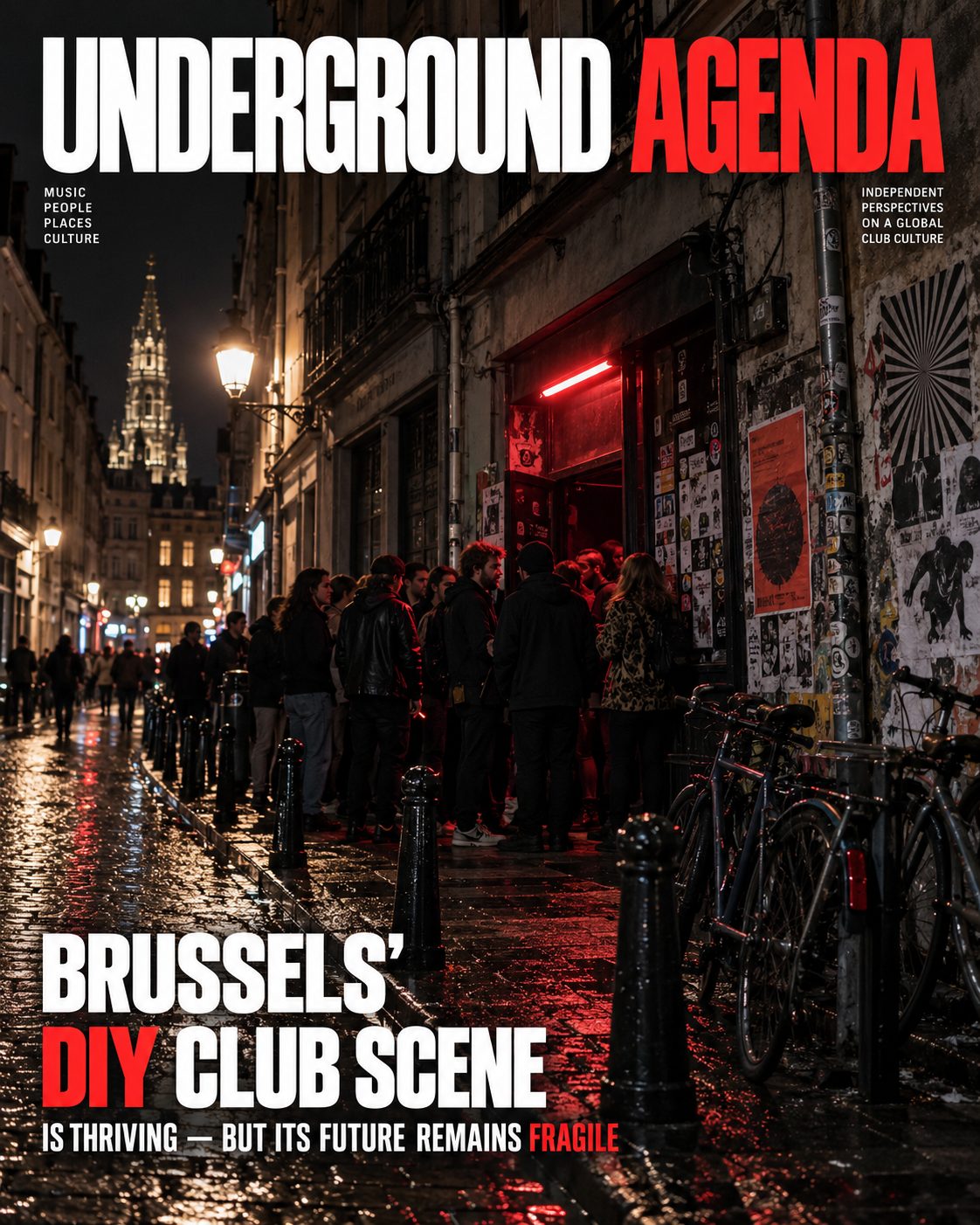
Brussels has quietly become one of Europe’s most interesting cities for underground electronic music.
The Belgian capital is currently experiencing a strong DIY resurgence built around independent promoters, small venues, radio stations, record shops and local DJs rather than one dominant superclub.
Resident Advisor recently described the city as one of Europe’s most exciting places to dance, pointing to a nightlife ecosystem that has developed through a network of communities rather than through a single institution.
That decentralisation may be exactly what makes Brussels feel different.
House, techno, bass and experimental club music move through different spaces and communities, creating a scene where identity is shaped by connections rather than hierarchy.
A scene without one centre
Brussels does not currently revolve around one club or one promoter.
Instead, its electronic culture operates through a constellation of spaces and organisations including Horst, Kiosk Radio, GIMIC Radio and Crevette Records.
Promoters and collectives such as Gay Haze, Gazelle Lhafla, Beautiful Freaks and BREAXX represent very different musical directions, from house and minimal to bass-heavy club sounds.
That variety gives the city a particular energy.
Instead of audiences moving toward one dominant sound, Brussels supports several overlapping scenes.
The result is less predictable than a nightlife ecosystem built primarily around international touring DJs.
Local artists matter.
At Horst Arts & Music Festival in 2026, around 40 percent of the lineup came from the local scene, with Brussels-based artists given extended and high-profile slots rather than being confined to opening sets.
That decision reflects a broader philosophy.
A strong underground scene cannot survive if local talent exists only beneath imported headliners.
It needs its own identity.
The strength of imperfection
Part of Brussels’ attraction comes from the city itself.
Its nightlife does not always feel polished or heavily institutionalised.
Spaces appear temporarily.
Collectives shift locations.
Parties are communicated through networks, radio stations, record stores and community channels.
That flexibility gives the scene room to experiment.
But it also creates vulnerability.
DIY culture is often celebrated because it can survive outside traditional structures.
The problem is that operating outside those structures also means living with less protection.
In late 2025, several Brussels venues closed within a short period, including RESET, La Cabane, Bonnefooi and Spirito. Each closure had different reasons, but together they exposed how fragile the city’s nightlife infrastructure can be.
RESET has since returned under a new identity as Hexagon, demonstrating the resilience of the local ecosystem.
But rebuilding repeatedly is not the same as stability.
Bureaucracy becomes part of club culture
The challenges facing Brussels go beyond rent and ticket sales.
Belgium’s administrative structure means nightlife venues operate across several different layers of government.
Permits, noise regulations, cultural funding and national legislation can fall under different authorities, creating a system in which responsibility for nightlife is fragmented.
Fuse provides one of the clearest examples.
The long-running Brussels techno institution faced the possibility of permanent closure in 2023 following a noise complaint from a nearby resident.
The club ultimately survived, but the dispute became symbolic of a larger European problem: venues that have operated for decades can suddenly become vulnerable when residential development changes the neighbourhood around them.
Brussels has since moved toward stronger protection through the introduction of an “agent of change” principle, intended to place more responsibility on new developments around existing venues.
It offers hope.
But regulations move slowly.
Nightlife operates every weekend.
Local scenes versus global booking culture
Brussels also highlights another issue affecting electronic music internationally.
As touring fees rise and promoters compete for the same group of recognised artists, festival and club lineups can become increasingly similar.
Local programming offers an alternative.
Rather than trying to reproduce Berlin, Amsterdam or London, Brussels has developed a scene that works because it reflects its own communities.
This may be its greatest strength.
The city does not need to become “the new Berlin.”
It needs the spaces that allow its existing culture to continue developing.
DIY needs infrastructure too
Underground culture often celebrates independence.
But independence does not mean a scene can survive indefinitely without structural support.
Clubs need permits.
Promoters need affordable spaces.
Artists need rooms in which to develop.
Audiences need regular places where communities can form.
Brussels currently has the creative energy required for a major nightlife city.
What remains uncertain is whether its institutions can protect that energy long enough for it to become sustainable.
The city’s DIY renaissance proves that underground culture can emerge even when conditions are difficult.
The next challenge is making sure those communities do not have to rebuild from zero every few years.
Brussels already has the scene.
Now it needs the infrastructure to keep it alive.