
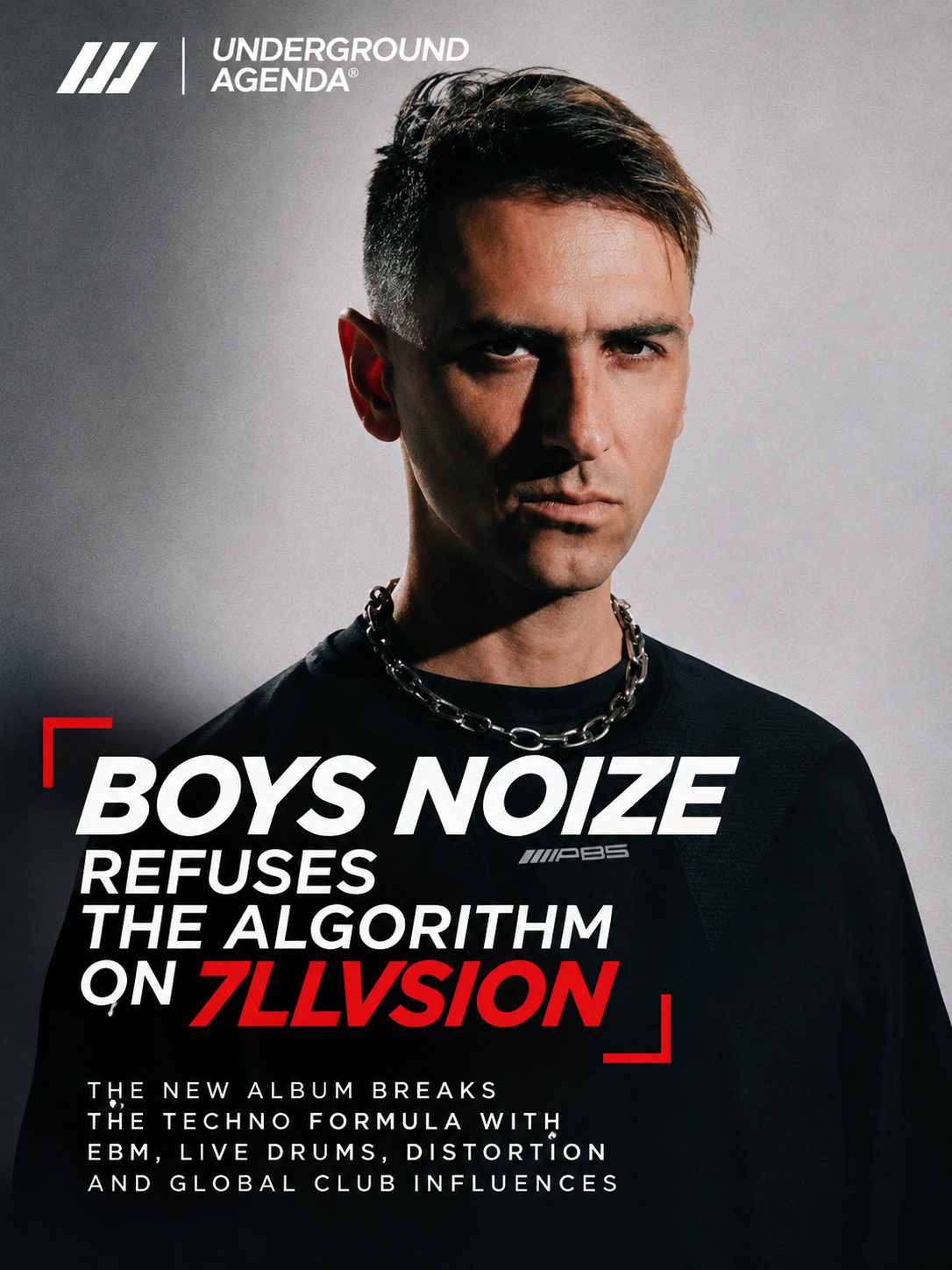
Boys Noize has spent more than twenty years refusing to stay inside one version of electronic music.
Electro.
Techno.
House.
Acid.
Industrial.
Rap production.
Pop.
Soundtracks.
Hardcore.
Now, with 7LLVSION, the Berlin-based producer has released one of the clearest statements of that philosophy.
The album arrived on November 6, 2026, through ONES AND ZEROS, and is Boys Noize's first solo full-length since +/- in 2021. His official discography lists it as his 2026 LP, while the record contains twelve tracks and collaborations with artists including Brutalismus 3000, ZEP, Locked Club, ABRA, Adame DJ, TAICHU, Taube and Mayah Alkhateri.
For Underground Agenda, what makes 7LLVSION interesting is not simply that Boys Noize has another album out.
It is what the album rejects.
According to the record's own statement, this is not a Techno album in the conventional sense.
It is an attempt to escape the repetition of an electronic landscape increasingly shaped by algorithms, recycled aesthetics and predictable formulas.
Alexander Ridha keeps changing shape
Behind Boys Noize is Alexander Ridha, a Berlin-based DJ and producer who has spent much of his career moving between scenes rather than remaining inside one.
His catalogue includes collaborations with Skrillex, Nine Inch Nails, Tiga, Rico Nasty, Shygirl, VTSS, Kelsey Lu and many others.
His official discography also documents recent work with Nine Inch Nails, Brutalismus 3000, Tame Impala, Ludwig Göransson, Keinemusik and Dorian Electra.
This movement is central to his identity.
Boys Noize has never seemed particularly interested in protecting a single genre.
He is more interested in distortion.
Pressure.
Rhythm.
And the sensation of music becoming physically unstable.
7LLVSION pushes that instinct further.
“Don't call it Techno”
The album's official Bandcamp text makes its position unusually explicit.
There are heavy kicks and synthesizers.
But the record deliberately resists being reduced to Techno.
Instead, Boys Noize frames it through Rock & Roll energy, live drums, distorted electronics and club music built to create physical collision rather than passive consumption.
That distinction matters.
Techno has become enormously visible over the last several years.
Large festivals.
Arena-sized Hard Techno.
Highly standardised drops.
Fast tempos.
Black visual branding.
Industrial imagery.
Once underground codes become successful, they can also become formulas.
Boys Noize appears interested in breaking that formula from inside.
The title itself looks corrupted
Even the name 7LLVSION feels digital and unstable.
It resembles a word that has passed through a damaged interface.
A title distorted by numbers.
Human language transformed by machine syntax.
That is appropriate for an album concerned with what happens when contemporary culture begins endlessly reflecting itself.
The record's own accompanying text describes the algorithmic age as an “endless present” in which culture is continuously recycled.
That critique sits at the centre of the album.
“Illusion” opens the door
The first track is simply called “Illusion.”
It establishes the conceptual frame before the collaborations begin.
The album then immediately moves into “1+1+1” with ZEP, followed by “Take Me Out” and the Brutalismus 3000 collaboration “Nächstenliebe.”
The sequencing is important.
This is not an album slowly warming into club functionality.
It begins in confrontation.
Brutalismus 3000 makes perfect sense here
Of all the collaborators, Brutalismus 3000 may be the most obvious match.
The Berlin duo have become closely associated with a generation that mixes Hard Techno, Gabber, Punk, Trance and deliberately abrasive performance.
Their collaboration with Boys Noize, “Nächstenliebe,” sits naturally inside the wider project and was released ahead of the album in October.
The pairing is interesting because it connects two generations.
Boys Noize emerged before social-media-era rave culture.
Brutalismus 3000 emerged inside it.
Both use distortion as language.
But they arrived there through different histories.
Live drums break the grid
One of the most distinctive elements of 7LLVSION is its emphasis on live drums.
The official album description specifically highlights rhythms that break away from the dominance of straight four-to-the-floor structures.
That choice changes the physical feeling of the music.
Electronic club tracks are often built around perfect repetition.
Live drums introduce instability.
Microtiming.
Variation.
Impact that cannot be completely quantised.
The machine begins to breathe differently.
“Baile DF” opens another geographical door
On “Baile DF,” Boys Noize collaborates with Adame DJ, with vocals from Thalia Abdon and MC DA FRANÇA.
The track brings Brazilian rhythmic energy into the album's wider industrial framework.
This is another key element of 7LLVSION.
The record does not attempt to create coherence by making every track sound identical.
The coherence comes from intensity.
Different styles are allowed to collide.
Locked Club enters the record
Locked Club appears on “Wake Me Up.”
The Russian duo have long represented a raw approach to Electro, Punk and live electronic performance.
Their presence reinforces the album's preference for energy that feels slightly uncontrolled.
Not polished.
Not symmetrical.
Not safely optimised.
This is important in a moment when electronic music production tools can make almost everything sound technically perfect.
Perfection is not always the objective.
ABRA brings another emotional dimension
ABRA appears on “I Need Luv.”
The collaboration continues a relationship already present in Boys Noize's previous catalogue, where the two worked together on “Affection.” His official discography lists that earlier collaboration alongside his wider 2021 material.
ABRA changes the emotional temperature.
Her vocals introduce vulnerability into a record otherwise defined heavily by pressure.
That contrast prevents the album from becoming one-dimensional aggression.
“Sh5b0mbe”
The strange title “Sh5b0mbe” arrives later in the album, another example of the record's fascination with language that looks partially machine-generated or corrupted.
Again, the visual language matters.
Numbers replace letters.
Words become codes.
Human expression and digital systems overlap.
TAICHU and Taube return in VIP form
“Shut It Down” appears on the album as an Extended VIP Mix featuring TAICHU and Taube.
The decision to use a VIP version is revealing.
VIP mixes historically emerge from DJ culture.
A producer modifies an existing track specifically for live use.
Different arrangement.
Different impact.
Different moment.
This reinforces Boys Noize's stated rule for the album:
Every track needed to work in his own live set.
That is an important limitation.
The album can experiment.
But it cannot become detached from the club.
“Ycore” and Mayah Alkhateri
The album closes toward its final stretch with “Ycore” featuring Mayah Alkhateri, before ending on “Sireneh.”
The result is twelve tracks that repeatedly move across different club languages without settling permanently in any of them.
That instability is the point.
His eighth album
The official album text describes 7LLVSION as Boys Noize's eighth album.
That longevity matters.
Artists often become more conservative with time.
Their sound becomes a brand.
Audiences expect continuity.
Festival bookings reward familiarity.
Boys Noize has repeatedly done the opposite.
His catalogue moves from electro to industrial electronics to pop production to soundtracks to collaborations with artists far outside conventional club culture.
From Frank Ocean to Nine Inch Nails
The breadth of his production history reinforces that point.
His official discography lists production work for artists including Frank Ocean, Lady Gaga, A$AP Rocky, Black Eyed Peas, Santigold and Dorian Electra, alongside his own extensive electronic catalogue.
In 2026, he also appears on projects involving Nine Inch Nails and Brutalismus 3000.
This ability to move between major pop infrastructure and more confrontational electronic scenes is unusual.
ONES AND ZEROS
The album is released through ONES AND ZEROS, rather than simply functioning as another standard BNR release.
The label identity fits the wider digital theme.
Binary language.
Machine logic.
Zero.
One.
Yet the music repeatedly attempts to escape machine predictability.
That contradiction feels intentional.
The algorithm becomes the enemy
The most interesting idea behind 7LLVSION may be its opposition to algorithmic culture.
Music discovery increasingly depends on systems optimised around similarity.
If you like this, listen to something almost like it.
Genres become behavioural categories.
Production adapts.
Tracks increasingly reveal their main idea quickly.
Attention becomes a metric.
Boys Noize instead appears interested in friction.
Music that demands bodies
The album's accompanying statement contrasts dopamine-driven digital culture with more physical ideas: adrenaline, oxytocin and collective bodily experience.
That distinction is important.
Electronic music began as technology-driven culture.
But its most powerful experiences remain physical.
Speakers.
Rooms.
People.
Heat.
Movement.
Contact.
No streaming platform can fully reproduce that.
No more dancing alone
The record's philosophy is therefore almost anti-isolation.
Electronic music may be created through machines.
But its purpose does not have to be solitary consumption.
The album is designed around collision.
Mosh-pit energy.
Club energy.
Bodies reacting to the same frequency.
That approach connects rave culture and Rock & Roll more naturally than genre purists might expect.
Boys Noize is not abandoning Techno
It would be too simple to frame 7LLVSION as Boys Noize rejecting Techno entirely.
Techno remains inside the DNA.
The machines remain.
The kicks remain.
The repetition remains.
What he rejects is the idea that those elements need to follow one currently successful formula.
This is a different distinction.
Techno as language remains useful.
Techno as template becomes limiting.
The most underground decision can be refusing the underground formula
Electronic culture constantly creates new codes.
Then those codes become recognisable.
Then marketable.
Then repeatable.
The cycle continues.
The underground eventually develops its own conventions.
Black clothing.
Industrial visuals.
Specific tempos.
Specific arrangements.
Specific drops.
Breaking those conventions can eventually become more underground than obeying them.
That may be where 7LLVSION becomes most interesting.
Looking backward and forward at once
The album pulls from older electronic traditions.
EBM.
Cold Wave.
Industrial music.
Rock.
Acid.
But it does not treat them as museum pieces.
They become material.
Reassembled inside a 2026 club context.
This is one way to escape the “endless present” the album criticises.
Do not simply revive the past.
Transform it.
Twelve tracks against sameness
The final tracklist is:
Illusion
1+1+1 (with ZEP)
Take Me Out
Nächstenliebe feat. Brutalismus 3000
HYYTUP
Baile DF feat. Thalia Abdon & MC DA FRANÇA
Wake Me Up with Locked Club
I Need Luv feat. ABRA
Sh5b0mbe
Shut It Down (Extended VIP Mix) feat. TAICHU & Taube
Ycore feat. Mayah Alkhateri
Sireneh.
Twelve tracks.
Multiple scenes.
Several languages.
One objective.
Break the mirror.
BOYS NOIZE — 7LLVSION
Released November 6, 2026
ONES AND ZEROS
12 tracks
Written and produced by Boys Noize.