
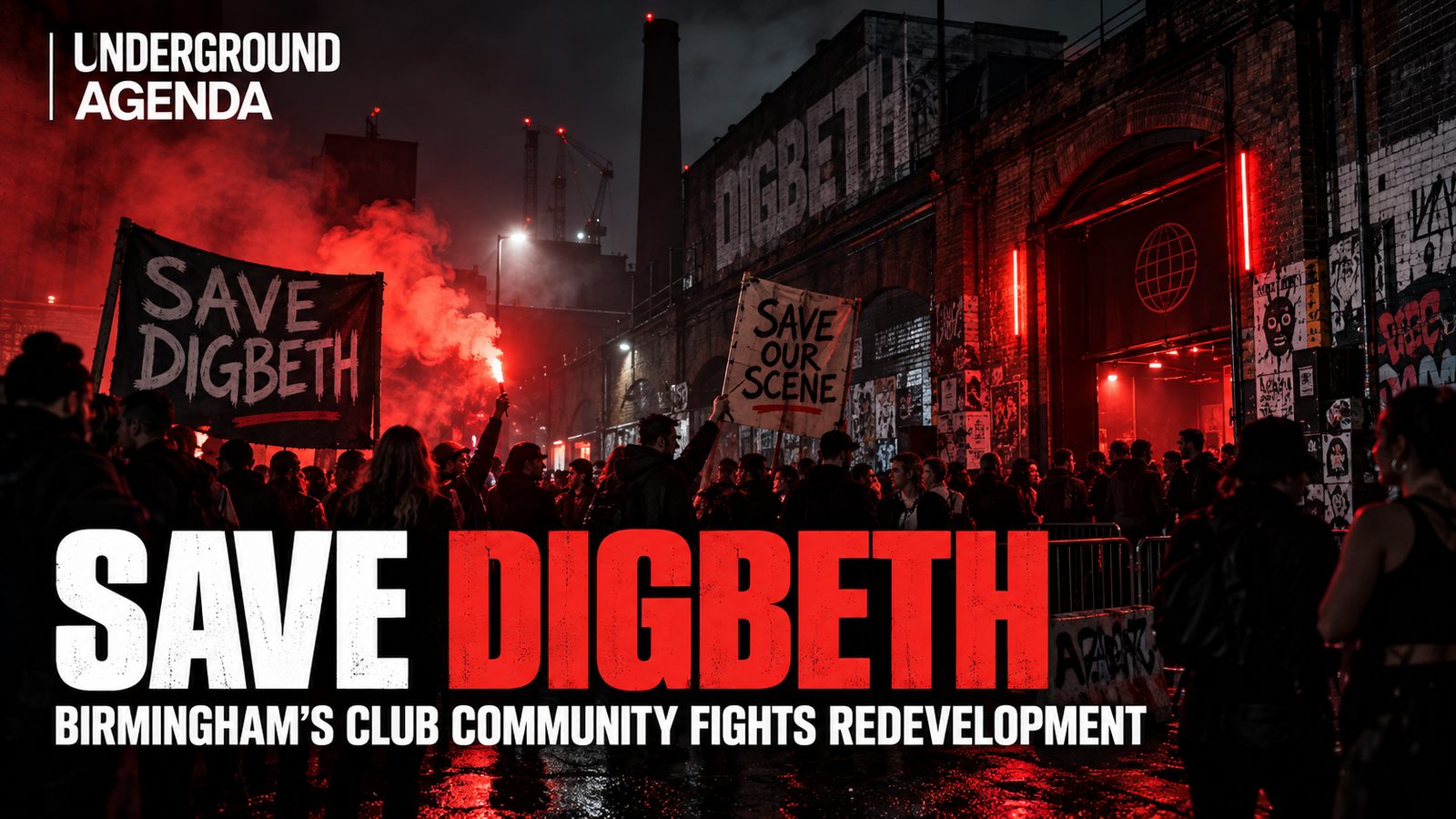
Birmingham’s underground music community has entered a new fight over the future of Digbeth.
A group of clubs and cultural venues in the district has united against proposed railway redevelopment plans that could put a significant part of the area’s nightlife infrastructure at risk.
The newly formed Digbeth Music Venues Alliance brings together spaces including XOYO Birmingham, Luna Springs, Club Colette, Mama Roux’s and The Night Owl.
At the centre of the dispute is the proposed Midlands Rail Hub, a major transport project that includes changes around Birmingham Moor Street Station and the Bordesley Viaduct.
According to campaigners, the redevelopment could directly affect Lower Trinity Street and threaten dozens of independent businesses in Digbeth, including several music venues. DJ Mag reports that around 50 independent businesses could be impacted by the proposals.
For an area whose cultural identity has been built around warehouses, railway arches, independent promoters and nightlife, the debate extends far beyond individual buildings.
It raises a familiar question for underground culture: what happens when infrastructure designed for urban development collides with spaces that have taken decades to become culturally significant?
Music as protest
On October 11, the campaign moved directly onto the dancefloor with the Save Digbeth Block Party.
The event took over Lower Trinity Street and surrounding venues with house, tech house and electronic music across multiple stages.
Artists announced for the campaign included Silva Bumpa, Fleur Shore, Low Steppa, Monki, Fat Tony, Jess Bays, TCTS, Illyus & Barrientos and others. Event listings confirm that the block party ran through October 11 into the early hours of October 12.
The event was not simply another addition to Birmingham’s club calendar.
It was designed as a visible demonstration of the relationship between the district and the people who use it.
Save Our Scene, the nightlife advocacy organisation involved in the campaign, describes its wider mission as protecting the UK’s live music ecosystem through community action.
In Digbeth, that idea becomes particularly concrete.
A neighbourhood’s electronic culture is rarely created by a single venue. It grows through networks of clubs, promoters, DJs, small businesses, artists and audiences operating within walking distance of one another.
Remove several of those spaces at once and the damage can extend beyond nightlife.
The network itself begins to disappear.
Why Digbeth matters
Digbeth has long been associated with Birmingham’s alternative cultural identity, and its industrial architecture has played an important role in the development of music spaces.
Former factories, railway infrastructure and warehouses have created conditions where electronic music, live events and independent nightlife could grow outside conventional entertainment districts.
That environment also provides something larger venues cannot always reproduce: entry points.
Local DJs can develop in smaller rooms. Independent promoters can test ideas. Communities can form before their sound becomes commercially viable.
Low Steppa, whose own project has deep connections to Birmingham, described Digbeth’s warehouse rooms and railway arches as spaces that gave DJs, producers and crowds somewhere to begin and belong.
That is why the current dispute has significance beyond Birmingham.
Across Europe, nightlife is increasingly negotiating with redevelopment, property values, infrastructure projects and changing urban priorities.
Clubs often occupy spaces that become valuable precisely because culture helped make their neighbourhoods attractive.
The paradox is familiar: underground scenes contribute to an area’s identity, then find themselves under pressure once redevelopment accelerates.
Culture is infrastructure too
The campaign against the Digbeth proposals is not framed simply as opposition to transport investment.
The Digbeth Music Venues Alliance has argued that the issue is whether cultural infrastructure is treated as something replaceable.
Its position is that progress should not require the destruction of an ecosystem without an equivalent cultural alternative being provided.
That distinction is important.
Transport infrastructure can transform a city.
But clubs, grassroots venues and independent cultural spaces also function as infrastructure — just of a different kind.
They produce communities, careers, creative networks and local identities.
The Save Digbeth campaign therefore represents something larger than a dispute over planning.
It is another example of underground culture being forced to demonstrate its value in terms that urban development can recognise.
For Birmingham, the outcome could determine whether Digbeth continues to operate as a living nightlife district or becomes another example of a scene remembered mainly after the spaces that created it have disappeared.