
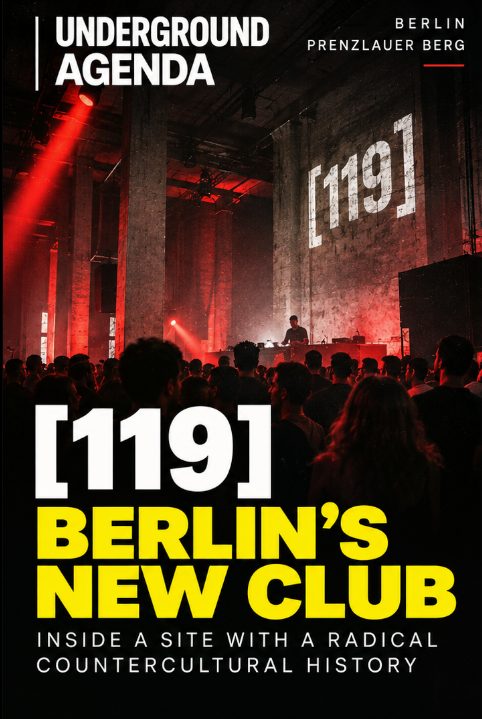
Berlin has a new electronic music space.
[119] opened on October 23 at Storkower Straße 119 in Prenzlauer Berg, introducing a two-floor club focused on House, Techno and contemporary electronic culture.
But the most interesting part of the story is not simply that another club has opened in Berlin.
It is where it has opened.
The building was previously home to Kirche von Unten — KvU, an organisation whose roots stretch back to East Berlin’s alternative and opposition movements during the final years of the German Democratic Republic.
That history gives [119] a weight most new clubs do not inherit.
The venue is beginning its life inside a building already shaped by decades of counterculture.
Two floors for a new chapter
The official opening introduced two separate musical environments.
The main Block floor featured DJ Traytex, Shanda, Rill, Hontas, TRIS and BBetriebswirt, while Halle hosted DEV and Choreophila.
House and Techno formed the musical foundation.
Rather than launching around one international superstar, [119] used its opening programme to highlight local sounds and establish the identity of the rooms themselves.
That is an important distinction.
New clubs often attempt to generate immediate visibility through major bookings.
[119] appears to be building from the opposite direction.
The space comes first.
Then the community.
Then the programme develops around it.
Nine-metre ceilings, concrete and steel
The physical character of the building already gives [119] a strong identity.
Local reporting describes approximately nine-metre-high ceilings, exposed concrete, steel structures and traces of previous uses throughout the site.
A Berlin creative team worked on the conversion during 2026, while deliberately retaining elements connected to the building’s past.
That decision matters.
Industrial architecture is constantly reproduced as an aesthetic in electronic music.
But there is a difference between a venue designed to look old and a building that genuinely contains several layers of cultural history.
At [119], those layers remain visible.
Before the club, there was KvU
The story of the location begins long before contemporary nightlife arrived.
Kirche von Unten was founded in 1987, during the final years of East Germany, and became associated with opposition, youth culture and alternative communities operating outside official state structures.
After several moves, KvU eventually occupied the Storkower Straße building before leaving the site in 2025 following a dispute surrounding the property. The organisation later relocated to Tiergarten.
For decades, KvU was much more than a conventional music venue.
It functioned as a social and cultural meeting point.
That creates a complicated inheritance for [119].
The new operators are not entering an empty warehouse with no previous identity.
They are entering a space whose earlier community had to leave.
Preserving traces of the past
The team behind [119] has publicly acknowledged that history.
The operators have said they intentionally preserved remnants from the building’s previous life and want to bring culture back into the location rather than erase what existed before.
Some visible details remain.
Old markings.
Architectural traces.
Elements associated with KvU.
The club therefore begins with an unusual challenge.
How do you create something new without turning the previous culture into decoration?
That question may become central to the identity of [119].
Berlin does not need another generic techno club
Berlin remains internationally synonymous with club culture.
That reputation creates opportunity.
It also creates repetition.
Concrete walls, long nights and Techno are no longer enough to make a space culturally relevant.
A new club needs a reason to exist beyond the aesthetic of Berlin nightlife.
[119] has the possibility of finding that reason through its location.
The building already connects politics, youth culture, music and alternative communities.
The challenge will be whether the new venue can develop a community strong enough to add another chapter rather than simply occupy the architecture left behind.
Part of a growing Storkower cluster
[119] is also opening inside a part of Berlin that is becoming increasingly dense with nightlife spaces.
Nearby are ROSA, the queer and kink-focused club that opened in the former Mensch Meier space, and DSTRKT, another electronic event venue.
Local coverage has described [119] as the third major nightlife space operating within this immediate Storkower Straße cluster.
That concentration could gradually create a new nightlife destination.
Instead of one isolated club, the area begins to function as an ecosystem.
Different audiences.
Different musical identities.
Different communities within walking distance.
Berlin club culture has often developed exactly this way.
Not through centrally planned entertainment districts, but through clusters that form around available spaces.
More than nightlife
The team has also indicated that [119] will not be limited exclusively to club nights.
Reporting around the opening mentions plans for concerts, fashion events and spaces for artists, with the outdoor area expected to be developed further for summer 2027.
This could prove important.
The strongest electronic venues often become culturally relevant because they allow different disciplines to overlap.
Music.
Visual art.
Fashion.
Performance.
Community.
The dancefloor may remain the central engine, but it does not have to be the only function.
A new space carrying an old history
Berlin has lost several major clubs in recent years.
At the same time, new spaces continue to appear.
That cycle is part of the city’s nightlife history.
But [119] enters the landscape with a particularly complex inheritance.
Its building already belonged to a countercultural community.
Its walls already witnessed alternative music and political activity.
Its identity cannot begin from zero.
That may ultimately be its greatest opportunity.
A new House and Techno club can be created almost anywhere.
A space with this history cannot.
The question is what [119] will do with it.
For now, the doors are open.
And another chapter of Storkower Straße’s underground history has begun.