Some clubs survive through buildings.
Others survive through memory.
Bar25 survived through music.
Twenty years after the creation of Bar 25 Music, the Berlin label born directly from one of the city's most legendary riverside clubs is celebrating its anniversary with a new 15-track compilation, 20 Years Of Bar 25 Music.
Released on November 13, 2026, under catalogue number BAR25277, the collection brings together artists including Pan-Pot, Rodriguez Jr., Frivolous, Oceanvs Orientalis, Gudrun Gut, Tobi Neumann, SCSI-9, Niconé, David Hasert, dOP, Mark Henning and Danny Faber.
But the importance of the anniversary goes far beyond another various-artists release.
Bar25 itself closed in 2010.
The label did not.
Sixteen years later, the music is still carrying a club that physically no longer exists.
A club built on the banks of the Spree
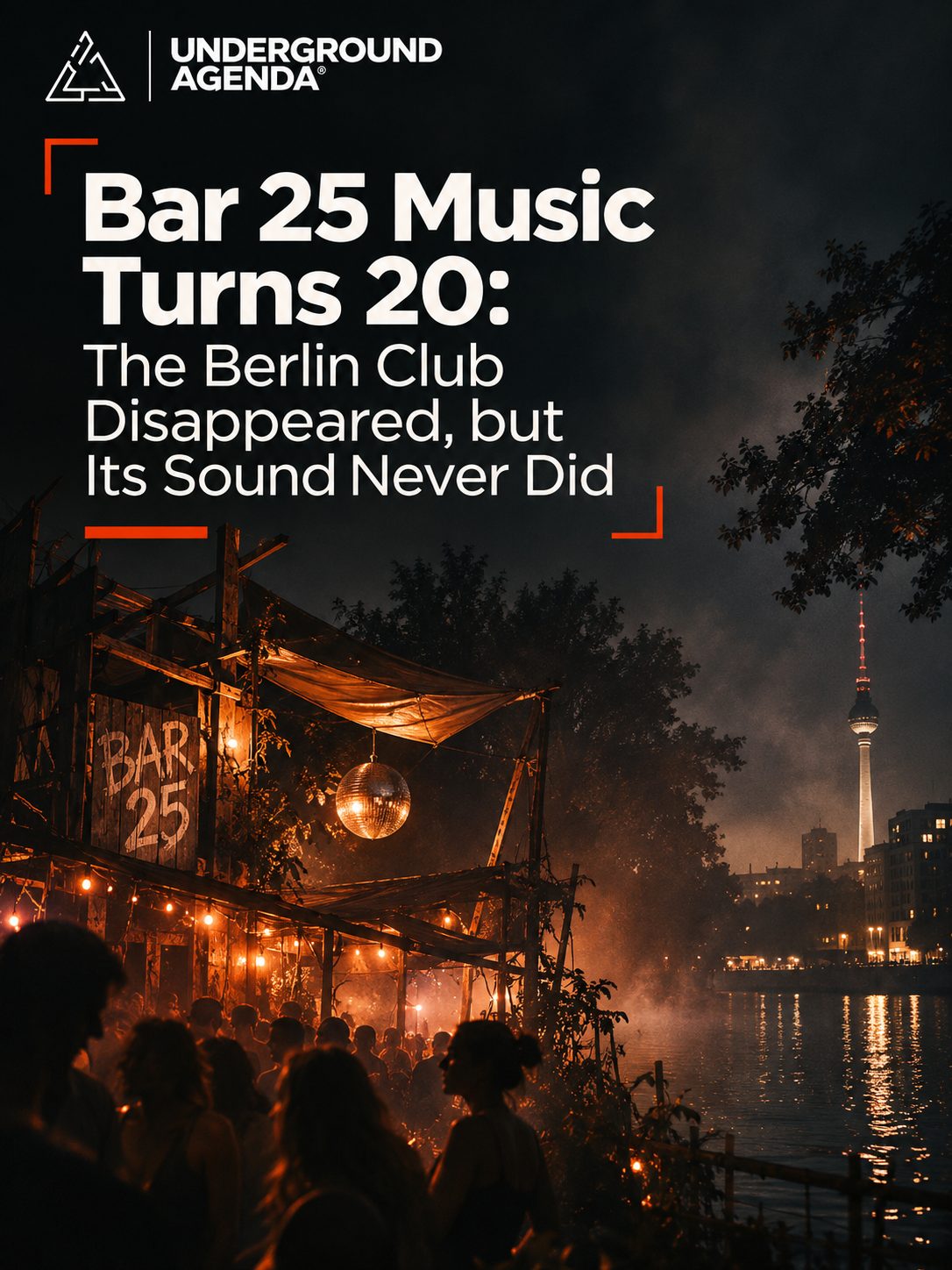
Bar25 emerged on a piece of wasteland beside Berlin's Spree River near Ostbahnhof.
It was never conceived simply as a room containing a DJ booth.
The space combined a club, bar, restaurant, hostel and circus-like environment, with weekends that could begin on Friday and continue deep into Monday.
That description already explains why Bar25 occupies such a particular position in Berlin history.
The club was less about entering a conventional nightlife venue and more about entering another temporary world.
The architecture was improvised.
The hours were elastic.
The distinction between audience and community became intentionally unclear.
This was Berlin before nightlife branding became globally standardised.
Post-wall Berlin was still physically unfinished
Bar25 belonged to a period when parts of Berlin were still defined by unused land, temporary structures and unresolved questions about what the city would become.
That environment gave electronic culture unusual freedom.
A club could exist because a forgotten location existed.
An empty piece of riverside land could become social infrastructure.
But temporary space remains temporary.
Development gradually changed the surrounding area.
In September 2010, Bar25 closed after a final celebration that lasted five days.
The party ended.
The brand did not.
Bar 25 Music had already been created
The record label had been established in 2006, while the club was still operating.
That decision became crucial.
Instead of allowing the musical identity of Bar25 to disappear when the physical location closed, the label created another form through which it could continue.
Four years later, the club was gone.
Bar 25 Music remained.
Today the label has surpassed 270 releases, according to recent anniversary coverage.
Few club-related labels survive their original venue for that long.
What did Bar25 actually sound like?
Trying to reduce the club to one genre would miss part of the point.
But certain characteristics became closely associated with its musical world.
Minimal House.
Deep House.
Melodic electronics.
Tech House.
Downtempo.
Music that could remain playful without becoming superficial.
The current label describes itself as cross-genre, with a core around melodic and vocal House extending toward indie dance, club House and electronic experimentation.
That breadth reflects the original location.
Bar25 was never designed around a rigid definition of underground credibility.
It could be strange.
Emotional.
Slow.
Groovy.
Sometimes almost theatrical.
The anniversary compilation does not simply recycle the archive
20 Years Of Bar 25 Music contains fifteen tracks, but the project is not structured as a conventional greatest-hits compilation.
There are new versions.
Rediscovered material.
Anniversary mixes.
Previously unreleased tracks.
Records revisited specifically for the occasion.
This distinction is important.
An anniversary can easily become nostalgia.
Bar 25 Music is attempting something closer to reconstruction.
The past is being reopened rather than simply replayed.
Iorie rediscovers “Catching The Dawn”
The compilation begins with Reecode – “Catching The Dawn (Iorie Remix)”.
According to the label, the remix originally appeared on SoundCloud and accumulated close to a quarter-million plays before being rediscovered during research for the anniversary and officially released.
That story feels appropriate for Bar 25.
Something floating informally through electronic culture eventually becomes part of the official archive.
Digital memory becomes catalogue.
Jo.Ke returns to “Thank You”
Jo.Ke revisits “Thank You,” recording new vocals for the anniversary edition.
Re-recording rather than simply remastering changes the meaning of the piece.
The track is not preserved under glass.
The artist returns to it years later.
Memory becomes performance again.
Gudrun Gut meets Tobi Neumann
Another important moment comes through Gudrun Gut – “Garten (Tobi Neumann Remix)”.
Gut occupies a much broader position in Berlin's experimental and electronic history, while Tobi Neumann has spent decades moving through House, Techno and the city's club ecosystem.
Their presence connects Bar 25 Music with a larger Berlin lineage.
The label never existed in isolation.
It belongs to a city whose scenes continuously overlap.
Rodriguez Jr. and the melodic side
Rodriguez Jr. contributes “Milos.”
Beatport categorises the track as Deep House, placing it within the warmer, more melodic side of the compilation.
This is another reminder that Bar25's legacy cannot be understood purely through harder Berlin Techno.
Berlin has always contained multiple electronic histories.
Bar25 represented one of them.
More colourful.
More playful.
More psychedelic.
Less interested in severity.
Oceanvs Orientalis widens the geography
Oceanvs Orientalis contributes “Teras.”
His presence demonstrates how far the label's musical network has expanded beyond the original Berlin scene.
The project connects electronic production with regional instrumentation and slower, hypnotic rhythmic language.
Twenty years later, Bar 25 Music is no longer simply documenting the sound of one riverside club.
It has become an international electronic platform.
Robosonic returns to the circus
Robosonic & Laura Weider contribute an Anniversary Mix of “Feldrecord im Zirkus.”
Even the title carries the memory of Bar25's circus-like environment.
This is where the distinction between archive and mythology becomes interesting.
For people who experienced the club, those references contain personal memory.
For younger listeners, they construct an imagined Berlin that existed before they arrived.
Music becomes a way of accessing a place that can no longer physically be visited.
Danny Faber remains inside the story
Label founder Danny Faber contributes “Clocks.”
His presence prevents the anniversary from feeling like an external retrospective.
The people who constructed the project remain inside its current catalogue.
Bar 25 Music describes the compilation as a thank-you to the artists and listeners who carried its records into new spaces over two decades.
That community emphasis is consistent with the club's original identity.
Mark Henning brings something genuinely new
Mark Henning's “Butcher” is previously unreleased material.
That detail may be one of the most important on the entire album.
A twentieth anniversary does not need to contain only things that already happened.
New music keeps the archive open.
Pan-Pot closes the compilation
The final track is Pan-Pot – “Ketasilie.”
Pan-Pot represent another part of Berlin's international electronic rise.
Their inclusion creates an appropriate endpoint.
A label born inside a temporary riverside experiment now closes its twentieth-anniversary compilation with artists whose careers became globally associated with Berlin electronic music.
The local scene became international.
The documentary preserved the building in another form
In 2012, the documentary Bar25: Tage außerhalb der Zeit reached cinemas, documenting the founders and the culture surrounding the club.
Film preserved the images.
The label preserved the sound.
Those two archives now carry much of what remains.
Nightlife disappears faster than we think
Club culture has an archival problem.
Buildings close.
Flyers disappear.
Websites vanish.
Social media accounts become inactive.
People move away.
Entire scenes that once felt permanent can become almost impossible to reconstruct twenty years later.
Bar25 is unusually well preserved because several forms of documentation survived.
Film.
Photography.
Stories.
And more than 270 releases.
A club can die without ending
This may be the real significance of the anniversary.
Bar25 lasted only a fraction of the label's current lifetime.
The physical venue closed sixteen years ago.
Yet younger DJs can discover Bar 25 Music today without ever having stood beside the Spree during one of its marathon weekends.
The sound detached itself from the architecture.
That is an extraordinary form of survival.
Berlin has changed
The riverside environment that allowed Bar25 to exist has also changed dramatically.
Property development transformed large parts of central Berlin.
Temporary cultural spaces became increasingly difficult to sustain.
The city that generated Bar25 cannot simply recreate the same conditions.
That makes the label increasingly valuable as historical evidence.
Not because everything was better before.
But because electronic culture needs memory.
Twenty years is not a finish line
Bar 25 Music describes the anniversary as both a celebration of its origins and a reason to continue forward.
That may be the correct way to treat club history.
Preserve what mattered.
Do not attempt to freeze it.
Release new music.
Bring younger artists inside the story.
Allow the meaning to change.
Bar25 disappeared from the banks of the Spree in 2010.
Sixteen years later, its records are still moving through dancefloors.
A club can close.
A culture does not have to.
20 YEARS OF BAR 25 MUSIC
Various Artists
Bar 25 Music — BAR25277
Released November 13, 2026
15 tracks featuring Reecode / Iorie / Jo.Ke / Rodriguez Jr. / Frivolous / Oceanvs Orientalis / Gudrun Gut / Tobi Neumann / SCSI-9 / Saktu / Robosonic / Laura Weider / Niconé / David Hasert / Dole & Kom / Danny Faber / dOP / Mark Henning / Pan-Pot.