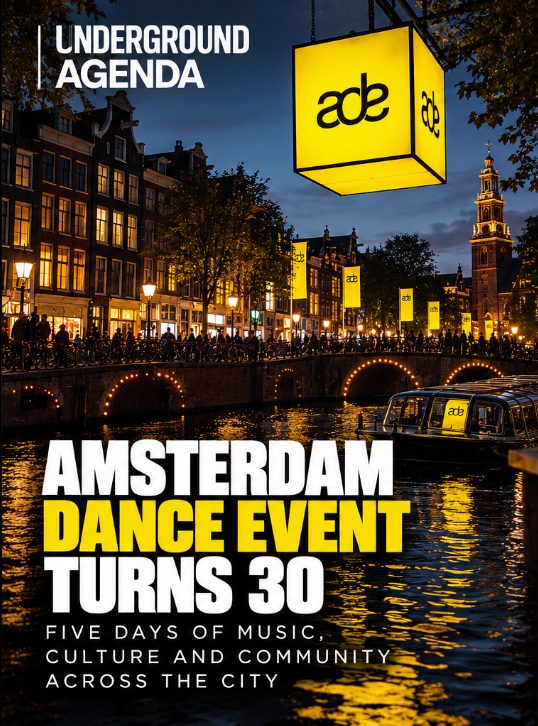
Amsterdam is about to become the centre of the electronic music world again.
From October 21 to 25, Amsterdam Dance Event returns for its 30th anniversary with its largest programme yet: more than 3,600 artists, over 1,300 events and more than 300 venues across the city.
Those numbers are enormous.
But ADE has never been interesting only because of scale.
What makes the event different from a conventional festival is the way it temporarily transforms an entire city into a network of clubs, cultural spaces, record stores, conference rooms, museums, warehouses and experimental venues.
For five days, electronic music stops belonging to one location.
It becomes part of Amsterdam itself.
Thirty years beyond the festival model
ADE began in 1996 and has gradually developed into something much broader than a nightlife programme.
Its 2026 edition combines the festival with ADE Pro, ADE Lab, music technology, visual art, talks, installations and cultural programming.
The official programme now spreads across more than 300 locations and includes artists from almost every corner of electronic music, from house and techno to bass, experimental electronics and large-scale dance music.
Among the names confirmed are Dax J, Djrum, Gerd Janson, GiGi FM, Len Faki, Mama Snake, Saoirse, SHERELLE and Speedy J, joining previously announced artists including Ben Klock, DVS1, DJ Stingray 313, Donato Dozzy, HAAi, Kerri Chandler, Octo Octa and DJ Nobu.
The breadth of that programme reflects one of ADE’s central strengths.
A superstar arena show and an intimate underground session can happen within the same city, sometimes only a few streets apart.
Underground culture inside a giant ecosystem
For underground electronic music, that scale creates both opportunity and contradiction.
ADE attracts major brands, global agencies, labels and some of the biggest names in dance music.
But underneath that infrastructure sits a huge network of smaller clubs, collectives and independent communities using the same week to present their own vision of electronic culture.
Club RAUM’s 55-hour SPIELRAUM programme, for example, includes artists such as DVS1, Dasha Rush, Octo Octa, Pariah and Kittin & The Hacker. Awakenings is running multiple events with artists including Ben Klock, Jeff Mills and JakoJako.
Elsewhere, small venues and free events offer a completely different experience.
That contrast is part of ADE’s identity.
The event works because there is no single version of electronic music dominating the city.
Instead, hundreds of scenes overlap.
When club culture meets art
The 30th anniversary edition is also expanding beyond the conventional dancefloor.
ADE’s Arts & Culture programme includes museums, churches and cultural institutions, with projects connecting electronic sound to visual art, performance and architecture.
Dutch artist Boris Acket will present EINDER, an 80-by-25-metre textile installation transformed continuously by large fans into an artificial moving sky. The work will be accompanied by live performances, including the Royal Concertgebouw Orchestra.
The opening programme at Gashouder also includes Swan Lake Remixed, combining classical ballet, hip-hop dance, electronic music and digital art. Demand was strong enough for an additional performance to be added.
These projects matter because they push electronic music beyond the idea that its culture exists only between DJ booth and dancefloor.
Sound becomes architecture.
Movement becomes part of the musical experience.
The city becomes the venue.
A changing underground landscape
ADE’s anniversary also arrives at a complicated time for European nightlife.
Clubs across Europe continue to face financial pressure, redevelopment, rising operating costs and changing audience habits.
At the same time, electronic music has rarely been more globally visible.
Techno, house and club sounds now appear on festival main stages, inside fashion campaigns and across major touring productions.
ADE sits directly inside that tension.
It is both an industry meeting point and a celebration of scenes that often developed far away from the mainstream industry.
That dual identity may be one of the reasons the event continues to matter after thirty years.
Its value is not simply the number of artists or venues.
It is the ability to put different layers of electronic culture in the same city at the same time.
Amsterdam becomes the network
From tomorrow, clubbers, artists, label teams, promoters, journalists and music professionals will begin moving across Amsterdam.
Some will spend the week inside conference rooms.
Others will move between warehouses until sunrise.
Many will do both.
That movement is probably the clearest definition of what ADE has become.
Not one festival.
Not one conference.
Not one scene.
But a temporary electronic city.
Thirty years after its first edition, Amsterdam Dance Event is no longer simply an event happening in Amsterdam.
For five days, Amsterdam becomes the event.